
Zelensky a vizite Beograd tès Sèbi a Inyon Ewopeyen-Risi balans Lwa
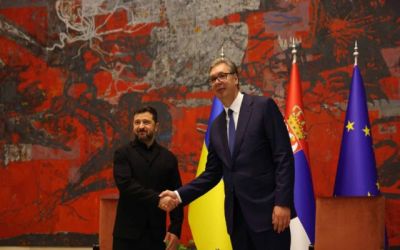
Premye vizit ofisyèl prezidan Ikrèn an nan Sèbi voye yon siyal politik bay Moskou ak Brussels.Men, gen ti prèv ke Beograd ap prepare pou abandone zak balans li yo depi lontan oswa enpoze sanksyon sou Larisi.
Volodymyr Zelensky’s first official visit to Serbia as Ukraine’s president at the weekend was symbolically significant because Belgrade has spent the past four-and-a-half years trying to avoid choosing between Kyiv and Moscow.
The visit will inevitably be read as a message to Russia. Some analysts have interpreted Serbia’s intensifying contacts with Ukraine as evidence that President Aleksandar Vucic is edging closer to the West. Yet it is too early to describe this as a geopolitical turn. The visit is better understood as another attempt by Vucic to widen Serbia’s room for manoeuvre while preserving the core elements of his Russia policy: no sanctions and no formal break with Moscow.
Zelensky had until now avoided visiting Serbia, wary of the government’s close ties to Moscow, its refusal to sanction Russia and strong pro-Russian sentiment in the country. Nevertheless, a senior Ukrainian official told AFP news agency that Ukraine needed to “pull the Serbs away from Russia”, describing the visit as a blow to Moscow.
For the Kremlin, Zelensky being formally received by Vucic weakens the notion that Serbia sits securely within Russia’s political camp. For Brussels, meanwhile, the visit gives Belgrade an opportunity to demonstrate that it can engage constructively with Ukraine even while refusing to align with EU sanctions against Russia. Right-wing politicians in Serbia, however, have warned that the visit could help Vucic strengthen his position ahead of the upcoming elections.
Despite the official announcement that the two presidents will discuss Serbia’s and Ukraine’s European paths, bilateral economic cooperation, and energy, some foreign media outlets suggested cooperation on defence could also be on the agenda.
The conservative German daily Frankfurter Allgemeine Zeitung has reported, without official confirmation, that the visit could involve discussion of a Serbian-Ukrainian drone venture, potentially financed by the United Arab Emirates.
Such a project would fit with Serbia’s efforts to expand its drone industry. Earlier this year, Vucic confirmed plans for joint drone production with Israel after a BIRN-Haaretz investigation reported that Israeli defence company Elbit Systems and Serbia’s state-owned Yugoimport-SDPR were planning a factory near Belgrade, with Elbit holding a 51 per cent stake. A Serbian-Ukrainian drone venture will not necessarily follow, but it does show that Belgrade is actively seeking foreign partnerships to develop its capabilities in unmanned systems.
For Zelensky, the visit is part of a broader effort to secure support for Ukraine’s war effort across a range of sectors. Energy cooperation and humanitarian assistance are relevant, but so is Serbia’s role in the supply of ammunition to Ukraine through Western intermediaries.
US ambassador Christopher Hill told Frankfurter Allgemeine Zeitung that, early in his posting in Belgrade, the US embassy had determined that Serbian arms producers could supply some of the military supplies urgently needed on the Ukrainian battlefield. Washington subsequently supported purchases of significant quantities of Serbian ammunition.
The Financial Times estimated such exports at roughly 800 million euros by mid-2024, a figure Vucic said was broadly accurate. In May 2025, however, he denied that Serbia was supplying Ukraine after Russia’s foreign intelligence service (SVR) accused the Serbian defence industry of “trying to shoot Russia in the back”.
Given that the United States played a direct role in bringing Serbia’s defence industry closer to Ukraine – even as Belgrade publicly maintained its policy of military neutrality and refusal to sanction Russia – Zelensky’s visit can also be understood as part of a move by Belgrade to court the Trump administration and demonstrate Serbia’s strategic value to Washington. That effort has become increasingly visible in recent years and has gained further momentum with the launch of the first US-Serbia Strategic Dialogue.
Serbia and Ukraine have maintained a more functional relationship since Russia’s full-scale invasion than Serbia’s domestic media environment might suggest. From the beginning of the war, Belgrade has formally supported Ukraine’s territorial integrity while refusing to impose sanctions on the Kremlin.
Serbia has backed UN resolutions affirming Ukrainian sovereignty, accepted Ukrainian refugees and provided financial, humanitarian and energy assistance. Kyiv, meanwhile, has not recognised Kosovo’s independence, enabling both governments to emphasise reciprocal respect for territorial integrity. Political contacts have steadily intensified. This has included meetings between Vucic and Zelensky on the margins of international summits, visits by senior Ukrainian officials such as Foreign Minister Dmytro Kuleba’s trip to Belgrade in 2024, and Vucic’s two visits to Ukraine in just over a year.
Yet Serbia’s foreign policy abroad and its political communication at home tell different stories. While the government formally describes EU membership as a strategic objective, much of the pro-government media ecosystem continues to cultivate anti-Western, anti-EU and pro-Russian narratives.
A 2026 Belgrade Centre for Security Policy study found that the narrative presenting Ukraine as a proxy in a wider Russia-West war was dominant in the Serbian pro-government press between early 2022 and mid-2025. Echoing Kremlin rhetoric, pro-government media portrayed Zelensky as Ukraine’s illegitimate president, while repeatedly depicting the country as subordinate to NATO and the West. Corruption scandals involving Zelensky’s inner circle have likewise been amplified by tabloids to portray the Ukrainian leadership as compromised.
The ruling party also echoed “colour revolution” rhetoric – that Serbia is being subjected to foreign subversion – through loyal media outlets, to delegitimise and justify the crackdown on mass protests against corruption, growing autocracy and political repression. There have been repeated warnings that the authorities would not allow another “Euromaidan in Belgrade”.
Zelensky’s visit creates a domestic communications challenge for Serbia’s president, particularly with his pro-Russian electoral base. The same media ecosystem that has spent years cultivating suspicion of Ukraine and hostility towards the West must now explain why Zelensky is being formally welcomed in Belgrade.
For tabloids such as Informer, the crucial message is not what the visit changes, but what it does not. Closer ties with Ukraine, and Zelensky’s visit to Belgrade, do not necessarily signal a shift in Serbia’s policy toward Russia, nor do they imply the introduction of sanctions. Vucic has already stated that Serbia defined its sanctions policy years ago and that this position will remain unchanged.
That is also a reason not to read too much into the visit. Just weeks earlier, Vucic was the only leader at a Ukraine-South East Europe summit in Kyiv who refused to sign the joint declaration calling for continued support for Ukraine and greater pressure on Russia. He also did not attend a ceremony honouring Ukrainians killed in Russia’s aggression. At the same time, Serbia is seeking to deepen economic ties with Kyiv to advance its bid for membership in the World Trade Organization, while continuing arms exports, exploring possible security and defence cooperation, and publicly reaffirming its support for Ukraine’s territorial integrity.
This is not necessarily a contradiction, but rather the essence of Vucic’s foreign policy: cultivating relationships with competing powers while avoiding commitments that would foreclose other options.