
A ‘symphony’ of wildlife suggests carbon financing is working in Sierra Leone
One of the first things H.S. Sathya Chandra Sagar noticed in Gola Rainforest National Park was its profusion of sound. Standing amid the tallest trees he’d ever seen, Sagar could hear the calls of countless birds, the hoot of primates, and in the distance, drumming: chimpanzees, beating fists and sticks on tree roots to check […]
One of the first things H.S. Sathya Chandra Sagar noticed in Gola Rainforest National Park was its profusion of sound. Standing amid the tallest trees he’d ever seen, Sagar could hear the calls of countless birds, the hoot of primates, and in the distance, drumming: chimpanzees, beating fists and sticks on tree roots to check in with faraway friends.
The din was a chorus of good news. Sagar, a conservation biologist, had traveled to the Sierra Leone national park as part of his Ph.D. research at the University of Wisconsin-Madison in the U.S. to try and figure out if economic measures aimed at conserving carbon in the Gola Rainforest also helped protect its animal biodiversity. In a study published in Conservation Science and Practice, Sagar and his co-authors find that its noisy soundscape suggests that it does.
“We see that if it’s done well, carbon financing initiatives do have the capability to protect both biodiversity, beyond just habitat, and carbon markets,” Sagar says.
Gola Rainforest National Park is one of the largest remaining portions of the Upper Guinean Tropical Rainforest, which once covered some 700,000 square kilometers (about 270,000 square miles) of West Africa. After a century of mining and logging, and a devastating civil war in the 1990s, Sierra Leone protected 700 km2 (270 mi2) of this forest that remained within its borders in 2010. In 2012, Sierra Leone established the Gola REDD+ project, a framework created through the United Nations Reducing Emissions from Deforestation and forest Degradation (REDD+) financing program. This program primarily rewards countries for not cutting down trees in the form of carbon credits, which can then be sold as offsets to higher-emitting countries.
Monitoring in Gola Rainforest National Park has shown that it’s a hotspot of biodiversity, and previous research found that the REDD+ interventions reduced deforestation by 30% in the park compared to neighboring areas. But nobody had connected the two: prior to Sagar’s study, research had not yet evaluated whether the birds and bugs, amphibians and mammals of any REDD+ protected area seemed to benefit from the reduced deforestation brought by REDD+.
To find out, Sagar and his colleagues took advantage of a unique landscape. Just across the border from the park, in Liberia, is an 800-km2 (309-mi2) protected area with similar wildlife and habitat, but no REDD+ financing. Gola also shares a border with a community-owned agroforestry region, which is not officially protected but receives REDD+ financing to limit deforestation. These different areas acted as living laboratories: by comparing biodiversity in each, it might be possible to tease out whether it was the REDD+ protection, or other factors, that influenced each area’s biodiversity.
The team chose two metrics as stand-ins for this biodiversity: soundscape saturation, and DNA richness. To measure the first, the researchers set up passive recording devices to capture all of the sounds audible at 133 sites, roughly split across the three areas, over 24 hours. The researchers then analyzed how much sound each recorder captured, and their respective frequencies, across every minute of the day.
Areas with a greater variety of sound frequencies are thought to be more biodiverse, according to the “acoustic niche” hypothesis: the idea that creatures living in noisy environments will adapt to unique frequencies so that they can be heard by their own kind amid the babel, like individual instruments in an orchestra.
The study found that soundscape saturation was significantly higher, all day long, in Gola Rainforest National Park than in the community area, and dropped off sharply at the border between the two. The researchers also confirmed that factors that weren’t affected by REDD+ — such as a difference in rainfall, slope or elevation — were roughly the same between the two areas.
These findings aligned what Sagar and his colleagues had been hearing in person: “If you’re walking from the community conservation area, you’re listening to a soundscape of very complex early morning sounds, but then you just jump onto the other side and immediately the chorus is like a symphony,” Sagar says. Their tests suggest that this symphony is indeed due to a greater diversity of species, rather than just more players in the orchestra.
Comparing across the border with Liberia, the effect was a bit murkier. The researchers found that their total soundscape saturations were similar, but that the REDD+ protected area showed more vocalizing species at dawn and midday, while the Liberian forest seemed to have a more diverse soundscape during the afternoon and dusk.
When the researchers compared the specific frequencies in each, they did find evidence that Gola Rainforest National Park had a higher number of unique insect and bird sounds, and more low-frequency sounds that are associated with larger birds and mammals. However, it’s hard to say whether this difference comes from the additional benefits of REDD+ or from greater hunting pressure in Liberia. Sagar is currently working on developing machine learning-based programs that will recognize both gunshots and the calls of commonly hunted species, like the western red colobus monkey (Piliocolobus badius), which he plans to deploy in both protected areas. He says this will help further tease out the impact of REDD+, and could provide important information to park patrols to mitigate poaching.
As a final test of REDD+’s impact, the researchers used a technique called DNA metabarcoding, which can identify many species’ DNA within a single sample. They collected these samples from large, tent-like netted bug traps, which often collected hundreds to thousands of individual arthropods at once, set up in both the REDD+-financed Gola and the community forest, but not the Liberian protected area. This allowed them to quantify how much difference came from disturbances, rather than solely the effect of REDD+.
What they found might seem, on the surface, contradictory: the total arthropod diversity was actually higher in the community forest than in the REDD+ protected area. However, Sagar says this isn’t too surprising, given that the community forest has many different types of habitat, and many insects thrive on human-created disturbance. This higher diversity also was not found across the board; there was greater diversity of DNA from flies, moths and butterflies in the community forest, yet beetle, ant, bee and wasp diversity were the same in both areas.
Overall, the study and its design are “elegant,” says Toby Gardner, a senior research fellow at the Stockholm Environment Institute, who wasn’t involved in this research. “It’s quite hard to evaluate differences in biodiversity due to an intervention [like REDD+],” Gardner says. “It’s very easy to find them, but to attribute them with some confidence to be due to the intervention is astonishingly difficult.”
Nonetheless, Gardner adds that these results are “persuasive” that REDD+ is positively impacting biodiversity. And more than that, both he and the study authors emphasize that the research proves that such low-cost, on-the ground monitoring can be a meaningful addition to climate finance projects, which usually only remotely monitor factors like tree cover.
“If we value forests as living ecosystems, which we do, we want to know how well we are protecting them as living ecosystems, rather than just repositories of carbon,” Gardner says. “It’s increasingly clear we need ecosystems that are resilient to disturbance, and that resilience comes from biodiversity. Unless we invest in understanding this, rather than just preventing people from clearing forests, we’re only doing part of the job.”
Although his Ph.D. tenure at Madison is ending, Sagar is continuing to analyze data collected from Gola with the aim of doing just that. In addition to his work on programs to identify hunting, he’s processing more environmental DNA data collected from streams to figure out how mammal diversity is different across these areas. And he says he’s helped make the technology and techniques he used available to local conservationists, working in Gola, to strengthen their monitoring efforts.
“I am a conservationist first, and then an ecologist later,” Sagar says. He adds he hopes collecting this type of data over the long term might help local people address some of the reasons behind the differences his team found, and take action to address them. “Trends are amazing, but we already know a lot about trends. We need actionable science.”
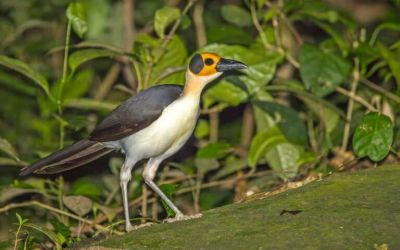
Banner image:The remnants of Upper Guinean Tropical Rainforest within Sierra Leone are home to a multitude of species, many of them threatened, such as the white-necked rockfowl (Picathartes gymnocephalus). Image by Charles J. Sharp via Wikimedia Commons (CC BY-SA 4.0).