
See the Stunning Medieval Manuscript Telling Tales of King Arthur, in Ink and Polished Gold, That's Headed to Auction
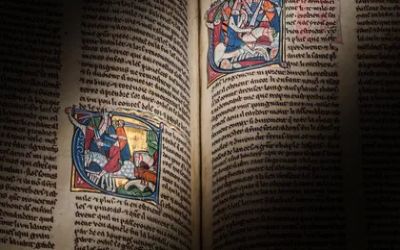
The manuscript was made by a skilled, anonymous artist between 1290 and 1310. It's the oldest of only three privately owned Vulgate Cycle manuscripts
The text is an illuminated manuscript. Its illustrations contain precious metals. CHRISTIE'S IMAGES LTD. 2026 More than 700 years ago, an anonymous scribe set down the tales of King Arthur and his Round Table in a vellum manuscript. He punctuated the Old French text with 126 miniature illustrations adorned with polished gold leaf, depicting the legendary British king, shape-shifting wizard Merlin and knights like Lancelot and Gawain.
Now, that manuscript is headed for the auction block in July, and it’s predicted to fetch more than $2 million. According to auction house Christie’s, the artifact dates to between 1290 and 1310, and it’ll be the oldest version of the Vulgate Cycle ever auctioned.
“This is a rediscovered manuscript of one the greatest of all medieval romances … texts fundamental to Western culture,” says Eugenio Donadoni, Christie’s senior specialist for medieval and Renaissance manuscripts, in a statement.
The Vulgate Cycle, also known as the Lancelot-Grail Cycle, was written anonymously in France in the 13th century. It’s a compilation of stories detailing the quest for the Holy Grail, the love affair of Lancelot and Queen Guinevere, the life of Merlin and more. In the 15th century, Thomas Malory drew on the Vulgate to write Le Morte d'Arthur, the first English-language prose book of Arthurian legends.
Only three contemporary Vulgate manuscripts are known to be privately owned, Donadoni tells the Guardian’s Donna Ferguson. “Ours is the earliest of the three and the most profusely illustrated. Its text is unique,” Donadoni says. “Many of the miniatures are in burnished gold, [created] using gold leaf, which was polished very aggressively to make it shine.”
The artifact has been dubbed the Clermont-Tonnerre Grail. According to Christie’s, the artist behind its illustrations is the anonymous “Master of the Liège Apocalypse,” from France—named for his work on another illuminated manuscript about the end of times.
“The illuminations in the Clermont-Tonnerre Grail, which are full of narrative detail, are among the richest examples of his work,” Donadoni tells the Telegraph’s Samuel Montgomery. “Characteristic of his style are the deftly drawn figures animated by the sharply contrasted black pupils of the eyes; neat orange dots carefully placed on cheeks; square-jawed male faces; and profiles exaggerated nutcracker chins and foreheads continuing in an almost straight line into a Grecian nose with an overlong tip.”
“It’s a beautifully illuminated manuscript, which contains wonderful Arthurian stories depicted in exquisite miniatures,” says Irene Fabry-Tehranchi, a French specialist at Cambridge University Library who’s written about the Lancelot-Grail Cycle, to the Guardian. “Originally, it was made for aristocratic patrons, possibly women who were very fond of Arthurian stories.”
Fabry-Tehranchi tells the Guardian that this manuscript’s “Suite Vulgate du Merlin” story has an abridged, rewritten ending—making for a “special version.”
“In some cases, scribes thought they could rewrite the story and make it more appealing to what either their patrons wanted or in a way that felt better [to them],” Fabry-Tehranchi tells the Guardian. “That was a standard medieval writing practice.”
Fabry-Tehranchi hopes that after seven centuries of private ownership, the Clermont-Tonnerre Grail will be purchased by a public institution. “This private ownership of a key medieval manuscript is a real challenge for scholars,” she tells the Guardian. “It prevents further research, unfortunately.”
“It has been a privilege to have been able to work on a manuscript of this rarity and calibre,” Donadoni says in the statement… “As Merlin himself prophesies in the text itself: ‘And the story will forever be told and gladly heard for as long as the world lasts.’”
Sonja Anderson is a daily correspondent for Smithsonian magazine who covers art, archaeology and culture, from newly discovered artifacts to the latest art heists.