
Vanilla, fake eggs and nausea: How Australian scientists are training foxes to avoid turtle nests
Researcher Ligia Pizzatto dug a small hole in the ground on the sloping banks of Ryan’s Lagoon in southeast Australia. She carefully placed an egg inside the hollow before covering it with soil, then reached for a large spray bottle and doused the area with a fine mist. The scent of vanilla filled the air, […]
Researcher Ligia Pizzatto dug a small hole in the ground on the sloping banks of Ryan’s Lagoon in southeast Australia. She carefully placed an egg inside the hollow before covering it with soil, then reached for a large spray bottle and doused the area with a fine mist. The scent of vanilla filled the air, oddly sweet against the smell of damp earth and eucalyptus trees.
While looking for another spot to repeat the process, Pizzatto came across a scattering of small bones, flat and almost geometrical in shape.
“Turtle bones,” Pizzatto said. “Probably eaten by a fox.”
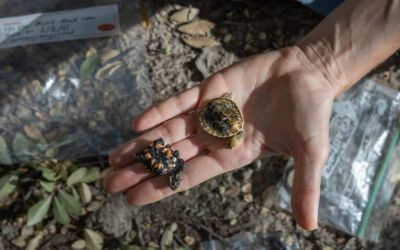
These bones are a small sign of a much larger crisis. Freshwater turtle species that are native to Australia’s Murray-Darling River Basin are increasingly under threat, their populations collapsing under pressure from introduced predators. Not only do foxes kill turtles that venture onto land — typically nesting females — but they also dig up their nests to eat their eggs.
Pizzatto, a biologist at La Trobe University in Victoria, is testing an innovative approach to intervene — one that doesn’t require killing a single fox.
The Murray River is the longest in Australia; its course marks the boundary between the states of Victoria and New South Wales in the country’s southeast. This river and its basin are a major biodiversity hotspot and home to three native turtle species: the Murray short-necked turtle (Emydura macquarii), the eastern long-necked turtle (Chelodina longicollis) and the broad-shelled turtle (Chelodina expansa).
While the IUCN, the global wildlife conservation authority, doesn’t currently list these species as threatened, experts say there’s a need for updated assessments. Locally, all three are under growing threat, with surveys showing population declines of up to 91% for at least one of the turtle species since the 1970s.
Foxes are “probably the main threat to turtles” in the basin, said Mike Thompson, a leading expert in turtle biology from the University of Sydney. But they are not the only threat.
Dams, locks and barrages built to control the river have significantly altered the waterway’s natural course and seasonal flow patterns. Vast volumes of water are diverted for human use every year — around 11,800 gigaliters (more than 3 trillion gallons) — enough to fill Sydney Harbour 22 times.
Combined with climate change, these shifts have led to more frequent droughts and degraded the wetlands that turtles depend on. To counteract this, the government releases some of the diverted water back to ecosystems that need it. But this is a politically contentious issue, and environmental water is often lower priority than private and industrial interests. In April 2026, hundreds of turtles died in New South Wales when state authorities halted environmental water flows following complaints from private landowners.
Turtles are also collateral victims of the roads and waterways that now cut through their habitat: They’re run over by cars, hit by boats and caught in illegal fishing nets.
Then there are red foxes (Vulpes vulpes), which pose the leading threat. They were first introduced to Australia in 1870 by settlers keen to continue the British tradition of fox hunting and have since spread across most of the continent. Many native species never evolved defenses against them, including freshwater turtles, which makes them easy prey. Foxes are killing them faster than populations can recover.
Conservationists are protecting the region’s turtle nests in various ways, from baiting and culling foxes to physically shielding nests with fences and plastic mesh. They’re also creating artificial islands — floating platforms covered in soil and anchored to the wetland floor, where turtles can nest away from the reach of foxes.
Along with providing needed water to wetlands, these techniques form part of what Thompson describes as a “multipronged approach to reversing the decline of freshwater turtles.”
While effective, each of these methods has its drawbacks. To install mesh barriers, every nest must be located and covered. Artificial islands are costly — up to $7,000 — and may leave nests exposed to predators that can swim or fly, such as birds, aquatic reptiles and water rats.
Culling, which is typically done by shooting or baiting foxes with poisoned meat, isn’t always effective or practical. Research suggests that even when fox numbers are reduced, turtles remain at risk, as surviving foxes can adapt and may hunt even more intensively. Baiting is difficult to implement in suburban areas, where risks to people and pets are higher. And while people tend to be more accepting of culling non-native species, attitudes toward lethal control remain polarized.
Pizzatto and her team are developing a non-lethal approach to protect turtle nests from foxes using a behavioral technique called “conditioned taste aversion.” By planting decoy eggs laced with a substance that causes stomach upset, they are teaching foxes to associate turtle eggs with nausea.
From his perspective as a turtle expert, Thompson sees promise in the approach. Like some other methods, it requires considerable labor, he noted, but if it works, it would “add another tool to the toolbox,” which conservationists need.
Pizzatto hopes to develop an accessible protocol that could complement existing approaches and be easily replicated by local communities.
At La Trobe University’s biology lab, Pizzatto put on a white coat and a pair of latex gloves. Laid out in front of her was a carton of chicken eggs, a jar of beeswax pellets, a large bottle of vanilla extract and a set of scales.