
Finance minister terms proposed FY27 budget as 'significant progress' in path to economic growth
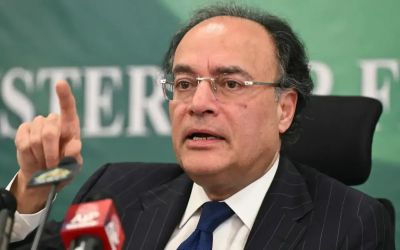
Finance Minister Muhammad Aurangzeb on Saturday termed the proposed budget for FY26-27 as a significant move towards setting the country on the path of economic growth. “In this budget, we have made significant progress in that direction of travel [towards economic growth] that we spoke earlier about,” he said at the outset of his media briefing in Islamabad. The minister affirmed that the governm
Finance Minister Muhammad Aurangzeb on Saturday termed the proposed budget for FY26-27 as a significant move towards setting the country on the path of economic growth.
“In this budget, we have made significant progress in that direction of travel [towards economic growth] that we spoke earlier about,” he said at the outset of his media briefing in Islamabad.
The minister affirmed that the government has “made comprehensive efforts to create an enabling environment” for an export-led growth, recalling the abolishment of an advance tax.
He stressed the decision to reduce the super tax for businesses earning more than Rs500 million, terming it a “very meaningful direction of travel”.
During the budget presentation yesterday, the finance minister announced that super tax would be abolished for businesses earning between Rs150m and Rs500m annually, and it would be reduced from 10pc to 8pc for businesses whose income exceeded Rs500m.
Aurangzeb said he proposed the abolishment of the super tax for “all exporters”, as per the directives of Prime Minister Shehbaz Sharif.
He further noted the matter also pertained to “financing rather than just taxation”. He added that an additional subsidy of Rs70 billion has been proposed in the budget to take the Export Refinance Scheme (EFS) “to a different level”.
“Macrostability is basic hygiene. It is as simple as that. If there would be forex reserves, interest rates, foreign exchange, and consistent policies in this country, then local investors would come first, followed by foreign investors,” Aurangzeb remarked.
Referring to the freeze on provincial development allocations, the finance czar lauded the provinces for stepping up and “helping us in some of the most pressing needs”.
“Some of those have been reflected in the defence budget,” he said, adding that the arrangement was expected to remain in place for the next three years.
On another question, Aurangzeb asserted that the issue was “not a lack of resources”, noting that Rs4.3bn had been allocated for the uplift plans for the entire country.
He emphasised the need to move towards the public-private partnership (PPP) model, so that the private sector could be promoted.
Asked about rumours that the Board of Investment (BoI) and the Special Investment Facilitation Council (SIFC), the minister said the merger of various ministries was part of the government’s rightsizing exercise.
“As far as BoI and SIFC are concerned, duplication can be seen in them; both have similar objectives of investment and facilitation. Therefore, a joint secretary was appointed, but it is best if foreign investors use and work with a one-window [system],” he said.
The finmin said Prime Minister Shehbaz Sharif has “made the principal decision to merge them”, with the process yet to be determined.
‘Entire budget is for export-led growth’
Speaking about tariffs, the finance minister noted that the government was in the second year of the five-year plan “in terms of bringing the cost down in terms of intermediate goods and the raw material”.
He stressed the importance of reducing the “trade deficit for goods”, adding that the services exports, particularly IT, were “becoming more and more important as we go forward”.
He said IT exports were expected to reach $4.5bn and that the overall “goods and export data for next year is very good”.
“This is why the government has announced to maintain the 0.25 per cent Final Tax Regime (FTR) as per the discussions that came through the IT industry, freelancers and PASHA,” he said.
Aurangzeb emphasised that the government tried to “provide relief to the lowest segments of the salaried class”, recalling that the slabs of 5pc and 15pc were reduced to 1pc and 13pc, respectively.
Meanwhile, Federal Board of Revenue (FBR) Chairman Rashid Mahmood Langrial said the “entire budget is a budget for export-led growth”.
Noting that there was a limited market within Pakistan to sell locally-manufactured goods, he said, “Unless you sell those goods abroad, poverty will not decline in Pakistan.”
He observed that there were two sets of people for reducing poverty, with the Benazir Income Support Programme (BISP) addressing the set that cannot become a part of the economic activity and “would be left behind in any system”.
Taxation
On taxation, the finance czar emphasised the aspects of “both deepening and broadening” the revenue collection.
Affirming that digital monitoring and other measures were already leading to additional revenues, he noted that a “new tax model” presented in the parliament yesterday was in design.
“We want to take this towards automation and AI, and reduce human intervention,” he said, mentioning that the retailers’ scheme has been proposed to widen the tax base.
Noting that questions had been raised about economic growth, rather than stabilisation, Aurangzeb asserted: “We have fully utilised the fiscal space available to us. There is more to do […] The feedback we have received so far is that we have set out on the path to economic progress.”
Responding to a question, the finance minister clarified that the petroleum levy was not being increased.
However, he acknowledged that the government “keeps interchanging the amount between petrol and diesel”, but there was no proposal to increase it.
About the recent surge in oil prices, Aurangzeb said that the impact of the Middle East conflict “will spill over into the next fiscal year”.
“Whether it is the supply or the prices, we have built in that redundancy into our fiscal position for the next year,” he added.
Replying to a query, the finance minister pointed out the abolishment of taxes on contraceptives and sounded the alarm on Pakistan’s high population growth rate.
“If today, with a population of 250m, you are highlighting there is child-stunting and learning poverty, which is primarily girls out of school, then can you imagine what will happen if we reach 300m to 400m?” he said.
Terming it an “existential issue”, he affirmed that the government was working on a comprehensive plan. “When the next NFC (National Finance Commission) award is allocated, this particular allocation driver has to be reviewed and has to change,” he said, referring to population.
At one point during the press conference, responding to speculations before the budget was proposed — such as an increase in the sales tax — Aurangzeb quipped that the reporters should hold their sources “accountable” for the incorrect information they were given.
Speaking during the press conference, Minister of State for Finance Bilal Azhar Kiani termed the proposed financial plan a “budget of the salaried class, industrialist, exporter, construction sector, the person who does not have the resources to build their house”.
Acknowledging that the salaried class was at the top of the list of those bearing the burden of taxation, he said that relief was given this year in such a way that “every person would feel a significant reduction in that burden”.
Replying to a question, Kiyani highlighted that the government had prioritised the lowest-income slabs — those earning up to Rs2.2m — and provided them relief.
Kiyani said that the abolishment of the advance tax for exporters and six slabs of the super tax were the “primary demands” of the exporters and the formal industry.
The state minister affirmed that the government heard the concerns of all chambers of commerce and addressed them.
He further noted that some taxes had notable importance for the social sector, such as taxes on sanitary pads and contraceptives, which would be abolished.
Also speaking at the press briefing, Information Minister Attaullah Tarar noted that the space for relief was “not created overnight”.
He also hailed the FBR reforms as “unprecedented”. “It would not be wrong for me to say that the entire structure of FBR is free of references and political influence,” he asserted.
Tarar highlighted the government’s steps to improve transparency and curb leakages, particularly in the sugar industry.
Agri sector
Aurangzeb noted that agricultural credit and financing had risen by 15pc year-on-year (YoY) and the overall agri-financing has crossed Rs2 trillion. He highlighted that the Zarkhez-e Scheme for small farmers was collateral-free and was “moving in the right direction”.
The overall size of the Prime Minister’s Youth Business & Agriculture Loan Scheme (PMYB&ALS) was Rs262bn, out of which Rs125bn were allocated for agriculture, he noted.
The finance czar underscored the need for “value addition” in the equipment imported, such as combined harvesters, tractors and centrifugal pumps. “The customs duties and regulatory duties on all these things were reduced to zero,” he added.
Speaking about the construction sector, the minister said housing and construction “play a very important role” for a “pro-business and pro-growth direction” of the economy.
In his remarks, Tarar observed that 12 industries “feed into the housing sector”.
He mentioned Prime Minister’s Apna Ghar Programme, for which additional allocations have been proposed in the budget.
On all duties, if we import agricultural equipment, combined harvesters, and other machinery needed by farmers and investors, wherever there is value addition and a need for machinery that is not locally produced, and we import it from abroad, then to increase productivity and address these needs, all customs duties and regulatory duties have been reduced to zero.
On Friday, the finance minister presented the proposed FY27 budget before the National Assembly, announcing a three-year freeze on provincial transfers as the government reallocated resources for security needs and relief measures for the salaried, corporate, real estate and export sectors to revive struggling economic activity.
In his third budget — and the fifth of the major coalition partners — the minister has proposed taxes on social media earnings, a fixed tax scheme for small traders and shopkeepers, a higher minimum tax rate for wholesalers and retailers, incentives for small electric vehicles and bikes, and barriers for luxury e-vehicles.
More to follow