27 Moon Bears rescued from illegal Laos bile farm
In what was described as the largest bear farm rescue in Southeast Asia, authorities in Laos in conjunction with the international NGO Free the Bears freed 27 Asiatic black bears from a foreign-owned illegal bear bile farm in Laos. All 27 rescued bears were transferred to the Luang Prabang Wildlife Sanctuary, operated by Free the […]
In what was described as the largest bear farm rescue in Southeast Asia, authorities in Laos in conjunction with the international NGO Free the Bears freed 27 Asiatic black bears from a foreign-owned illegal bear bile farm in Laos.
All 27 rescued bears were transferred to the Luang Prabang Wildlife Sanctuary, operated by Free the Bears, the organization said in a press release.
“No animal should endure such cruelty,” Matt Hunt, Free the Bears CEO, said in a statement. “And we’re so glad we can now bring these 27 bears to the safety of our sanctuary where they can join more than 150 other bears rescued over the past 23 years.”
The NGO said the bear bile facility was owned and operated by a Chinese national and was registered as a zoo to evade regulatory oversight, while operating as a commercial bile extraction site.
During the raid, rescuers discovered infrastructure designed to hold up to 200 bears, suggesting a planned industrial-scale expansion that was thwarted. The rescued bears, aged between 1 and 3, are believed to have been poached from the wild as cubs, the NGO said.
Bear bile farms across Southeast Asia often keep Asiatic black bears (Ursus thibetanus), sometimes referred to as moon bears, in tiny cages, where their bile is extracted from their gallbladders for use in traditional medicine.
“However, much of the use of bear products appears to be based more on traditions and beliefs than on actual medicinal values,” Chris Shepherd, senior conservation advocate for the U.S.-based NGO Center for Biological Diversity, told Mongabay by email. “[T]here is no reason to rely on bear bile as there are many legal synthetic and herbal alternatives to bear bile that are equally effective or even better, and therefore the use of bear bile is unnecessary and not critical.”
Laos has updated its laws to remove the legal loopholes that previously protected older bear bile farms, making all commercial trade and exploitation of moon bear strictly illegal. However, the trade is shifting to digital platforms like Facebook that are challenging to monitor, Mongabay previously reported.
Shepherd said it would be difficult to release the rescued bears into the wild since they were poached as cubs.
Young bears spend the first few years of their life learning survival skills from their mother, he said. “Cubs captured and kept in bear farms are deprived of this essential period of their life with their mother and, therefore, lack the skills they need to survive on their own.”
Shepherd added the conditions inside bear farms are “horrific,” and the bears are weak and often crippled from being in small cages; some cannot even stand up. This would make their survival in the wild “impossible,” he said.
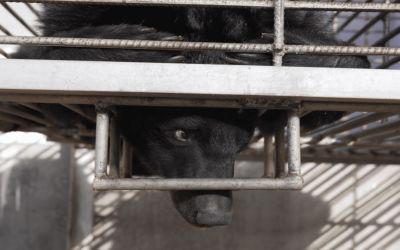
Banner image of a caged moon bear in the illegal Laos bile farm, courtesy of Free the Bears.