
How one Haitian mom’s journey put son on path to become NYC’s Health Commissioner
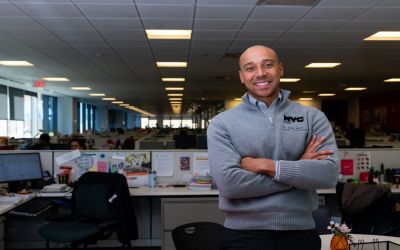
“Growing up was, if there was ever something that I felt like I couldn't do, my mom would say, ‘You have the blood of Dessalines in you. You have greatness in you. You have resilience in you.” The post How one Haitian mom’s journey put son on path to become NYC’s Health Commissioner appeared first on The Haitian Times.
New York City Health Commissioner Dr. Alister Martin reflects on his Haitian upbringing, his mother’s journey from immigrant worker to global professional and cancer survivor in this wide-ranging interview. His story also highlights a commitment to community-rooted public health that seeks to address social ills as well as treat health problems.
NEW YORK — At 11 years old, a boy in Jackson Heights overheard a startling conversation that put him on the path to becoming Dr. Alister Martin, commissioner of the New York Department of Health and Mental Hygiene (DOHMH). After his Haitian-born mother had been diagnosed with metastatic cancer, her friend asked what would happen to the boy when she died.
But, three years later, after chemotherapy, radiation and surgery, she was cancer-free.
“That was the first time I had seen superheroes in real life,” he said. “It was the first time I understood the power of medicine,” he said.
Today, Dr. Martin is leading one of the world’s largest public health entities. Appointed by Mayor Zohran Mamdani in January, Dr. Martin sits in one of the most influential public health roles in the world. In between those years, he earned his degrees in medicine and public policy from Harvard, worked as an emergency physician and assistant professor at Harvard Medical School, and served as a senior advisor to Vice President Kamala Harris.
Guiding him throughout and defining his leadership is the foundation his mother Sandra McKinley built — an upbringing rooted in Haitian pride and perseverance. Her journey from working as a fry cook at McDonald’s to earning multiple degrees and consulting for the United Nations, among several careers, has also inspired him to work hard and overcome challenges.
McKinley shared her thoughts on his appointment, in a statement to The Haitian Times:
“Haitian history teaches that adversity is not the end of the story. It teaches that liberty requires conviction, sacrifice and vigilance. It teaches that governance, self-determination and national dignity are inseparable from the refusal to accept dehumanization.
“For younger generations, this history is not simply a source of pride; it is a source of moral and political education. It reminds them that freedom is never handed down generously, but won through struggle and preserved through memory.
The interview with Dr. Martin, held in April, follows. It has been condensed and edited for clarity.
The Haitian Times: Congratulations on your appointment. What did it feel like to learn you were being considered and to actually get the job of being our city’s top doctor?
Dr. Alister Martin: Thank you very much. I have to say, it’s a privilege and an honor of a lifetime to be able to do this work of helping to keep the greatest city in the world healthy and safe.
For me, it was a homecoming. My earliest memories are of growing up in this little co-op that my mom, who immigrated to this country from Haiti, rented in Jackson Heights, Queens. I’m really excited to come back to help take care of the city’s residents, to demonstrate what it looks like when public health departments really take care of their people — and to provide that model for the country.
What I’ll say to that is, I might be the first health commissioner that’s of Haitian heritage or descent, but I will not be the last.
THT: So, yes, you mentioned your mom right off and growing up in Jackson Heights. What was your home life like then? What were some of the Haitian values your mom instilled that really stuck with you?
Dr. Martin: My dad left when I was very young. My experience in those days was, ‘It’s just my mom and I.’ She was my hero — is my hero — my best educator, my personal historian. She is the person who has taught me the importance of where we come from. The stories of Toussaint Louverture, Dessalines and the people who helped create the Haitian Revolution.
So my experience growing up was, if there was ever something that I felt like I couldn’t do, my mom would say, ‘You have the blood of Dessalines in you. You have greatness in you. You have resilience in you.’ I know that I’m made up of something different, that I’m somebody who can withstand and overcome challenges. That is directly related to the place where I come from.
THT: You speak so highly of your mom, and have shared how she went from being a fry cook at McDonald’s to a consultant at the United Nations. I imagine having that role model in your life, seeing her go through that evolution day to day, also had an impact.
Dr. Martin: It certainly did. Obviously, I love my mom, I think she’s the best in the world. But, you know, her story is not all that dissimilar from so many Haitian immigrants in this country. They understand the value of education, the value of hard work, the value of putting one foot in front of the other and just making it. Doing what needs to happen to provide for your family, to create the foundation that your family needs to be successful.
So, yes, my mom first started working at McDonald’s, like many other immigrants. But, she went on and got three master’s degrees. She later became a consultant for the United Nations — her first big career, flying all over Western Africa doing gender rights consulting work. She eventually became a public school teacher. After that, she became a nurse herself, in the program that I now run, through the health department. So it’s a real nice, full-circle moment.