UAE's ruling al-Nayhan family receives tens of millions in EU farming subsidies
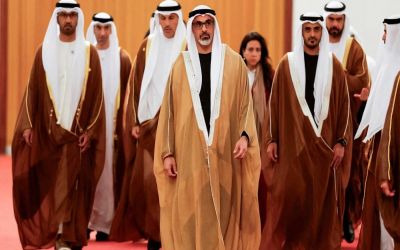
UAE's ruling al-Nayhan family receives tens of millions in EU farming subsidies Submitted by MEE staff on Fri, 05/08/2026 - 11:22 The world's second-richest family has acquired vast swathes of European farmland and is taking EU subsidies, DeSmog reveals
The United Arab Emirates’ ruling al-Nahyan family is benefiting from tens of millions in European Union subsidies to grow crops destined for the Gulf, according to a new investigation by DeSmog.
The independent investigative journalism organisation found that subsidiaries controlled by Abu Dhabi's royal family collected more than €71m ($84) over six years for farmland it controls in Romania, Italy and Spain.
The Al Nahyan family is the second richest in the world, with an estimated wealth of more than $320bn, mostly derived from the Emirates’ vast oil and gas reserves.
The EU pays out about $64bn each year to farmers and rural areas under its common agricultural policy (Cap). This accounts for a third of the union's entire budget, but an unknown amount of it ends up in the hands of foreign investors.
DeSmog, in partnership with El Diario and G4Media, said it reviewed data for thousands of Cap beneficiaries between 2019 and 2024, tracing 110 European subsidy payments to a network of companies and subsidiaries controlled by the Al Nahyans and Abu Dhabi's investment and holding company, ADQ.
The largest payment uncovered by the investigation came through the Romanian agricultural company Agricost, which owns the EU’s single largest farm, measuring 57,000 hectares, five times the size of Paris.
EU farm subsidies disproportionately benefit large landowners, DeSmog said. In 2024 alone, Agricost received over $10m in direct payments, which was more than 1,600 times the amount collected by the average EU farm.
The Al Nahyans and companies named in the investigation did not respond to multiple requests for comment from DeSmog. ADQ declined to respond.
In just over 15 years, the UAE has bought up vast swathes of land and agribusiness companies across Africa, South America and Europe. It now controls around 960,000 hectares of farmland worldwide.
This expansion forms part of the Emirates’ wider food security strategy, which aims to secure supplies for a country where high temperatures, water scarcity, and sandy soil make growing crops a major challenge. The UAE currently imports up to 90 percent of its food.
The desire to acquire more farmland has also been cited as a reason behind the UAE's involvement in the Sudan war, where Abu Dhabi backs the Rapid Support Forces paramilitary, which has been widely accused of genocide.
The UAE controls several land and farming operations in Sudan. International Holding Company (IHC), the UAE’s largest listed corporation, and Jenaan Investment are farming more than 50,000 hectares in Sudan. Abu Hamad’s farming project covers another 162,000 hectares of cultivated land.
Abu Hamad is a massive farming project led by IHC in partnership with Dal Group, Sudan’s largest private company. This project will link the agricultural area to a new Red Sea port, Abu Amama port, constructed and operated by AD Ports Group, which is based in Abu Dhabi.
The DeSmog investigation found that in the EU, the expansion has been channelled through three main companies, based in Spain, Italy and Romania.
Agricost, Romania’s vast farm, was bought by the Al Nahyans in 2018 for an estimated €230m ($270m) through Al Dahra, the UAE agribusiness group. Al Dahra was founded by President Mohammed bin Zayed Al Nahyan's brother Hamdan, before Abu Dhabi’s sovereign wealth fund, ADQ, purchased 50 percent of the firm in 2020.
No information on Al Dahra’s current ownership structure is publicly available, but DeSmog said it understood that it remains linked to individuals on the board, which is chaired by Hamdan, and his son, Zayed bin Hamdan, who is married to Mohammed bin Zayed's daughter.
Since 2012, Al Dahra has also acquired multiple farm companies in Spain, DeSmog reported. These are responsible for over 8,000 hectares of land and together received more than €5m (£5.9m) in Cap subsidies between 2015 and 2024.
According to the investigation, the UAE’s Spanish and Romanian farms both cultivate alfalfa and other crops for animal feed, with the majority of produce designed for export, including to the Gulf.
Al Dahra holds a long-term contract with the UAE government to supply animal feed for the country, partly used for its rapidly growing dairy sector.
In 2022, sovereign wealth fund ADQ also purchased Unifrutti, a fruit producer with an estimated worth of $830m ($976m). According to DeSmog’s analysis, Unifrutti’s Italian farms received at least €186,000 in Cap subsidies in the three years following the sale.