
Bosnian Idyll? Gulf Investors Sold Land They Can’t Build On
Land in Bosnia is being bought up by firms founded with Gulf capital, cleared of trees and sold to Gulf buyers, often Kuwaitis, for new homes that, by law, can’t be built, BIRN and ARIJ can reveal.
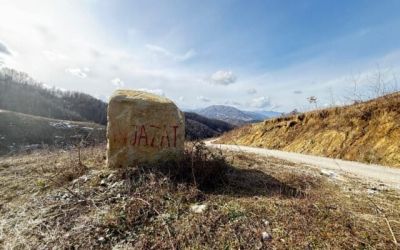
Near the village of Dobro, some 40 kilometres northwest of Sarajevo, a large stone sits on an expanse of empty land once covered in trees. The stone is inscribed with the word Injazat, which in Arabic means ‘achievements’ or ‘accomplishments’.
Three years ago, excavators were filmed clearing 18 hectares of forest at the site, the equivalent of 25 football pitches.
The filming was for a promotional video on behalf of a company called Poduhvati Buducnosti-Injazat Future, which had bought the land as part of a total of 60 hectares in the region of Visoko, central Bosnia and Herzegovina. The land was divided into plots, as if ready for sale.
The video portrays work in progress on clearing the land, apparently preparing it for construction. As yet, nothing has been built and it is unclear whether any of the plots have ever been offered for sale.
Nor could they be built on, given that – according to the findings of an investigation by BIRN and Arab Reporters for Investigative Journalism, ARIJ – local planning laws prohibit construction on much of the land bought by Poduhvati Buducnosti-Injazat Future since it is classified as agricultural land or forest and part of a protected water source zone.
Poduhvati Buducnosti-Injazat Future is owned by Kuwaiti national Nayef Abu Shaibah, who, BIRN and the Arab Reporters Network can reveal, has a record of selling land to Gulf investors for ‘residential’ purposes even when the law does not permit such construction.
In 2020, another of Abu Shaibah’s companies, named after its owner, bought 2.5 hectares in the central Bosnian village of Sutjescica, Breza municipality.
Divided up into plots, the land was advertised for sale for residential construction on the website of a Kuwaiti company called Injazat Future, where Abu Shaibah is chairman of the board. Design plans depicted the construction of 43 homes and a mosque. Every plot was subsequently sold, the Injazat Future website claims.
According to Breza’s spatial plan, however, the land is located in an area marked as at risk of landslides. Construction is only permissible if the developer completes a geological survey, rehabilitates the site, and obtains approval from the canton-level Ministry of Spatial Planning, Transport and Communications, and Environmental Protection confirming that the landslide risk has been dealt with.
Municipal council documents obtained by BIRN show that no such survey has been conducted and that authorities have not authorised any construction. Not a single house has been built.
“For reasons such as the risk of landslides or being under forests, this land is not suitable for construction at all, nor is it legally possible to build on it,” said Breza mayor Vedad Jusic.
Neither Poduhvati Buducnosti-Injazat Future, Kuwait-based Injazat Future, or Abu Shaiban responded to repeated requests for comment.
Headquartered in Kuwait City’s Mousa Trade Centre, Injazat Future has a website and Instagram feed populated with photos and videos depicting idyllic Bosnian landscapes and land plots for sale for the home of your dreams. It claims to operate in Bosnia, Egypt, Georgia, Germany and Turkey.
The Arabic-language promotional material is pitched at middle-income Gulf investors, a fact reflected in prices well in excess of the average market rate in Bosnia.
What Injazat Future doesn’t say is that some of the land offered for sale cannot, by law, be built on.
Instead, Abu Shaibah pops up on the company’s social media channels touting investment in Bosnia as a “strategic opportunity” given its future as a member of the European Union, a future most experts would argue is far from certain.
According to Abu Shaibah, since Bosnian law prohibits foreigners from directly owning land, buyers can register their purchase in the name of Poduhvati Buducnosti-Injazat Future or open a company in Bosnia that will act as the owner.
He offers headache-free ‘turnkey’ construction, i.e. from start to finish, and makes the dubious promise that a construction permit can be acquired in roughly a month.
There is no mention of two indictments filed by prosecutors in Zenica-Doboj Canton in July 2025 and February this year charging Poduhvati Buducnosti-Injazat Future and connected individuals with the criminal offence of forest devastation in Visoko over an area equivalent to 30 football pitches, including the land just outside Dobro. Abu Shaibah is not among the individuals charged. Proceedings are ongoing.
Comments on Injazat Future’s Instagram and TikTok profiles paint a less flattering picture than the one presented by Abu Shaibah.