
Despite restrictions, forest loss continues on Ituna land, home to isolated people
Illegal invasions in the Ituna/Itatá Indigenous territory in Brazil’s Pará state, home to isolated Igarapé Ipiaçava Indigenous people, has continued despite being protected by one of the latest land use restriction orders, in 2022, according to satellite analysis by Mongabay. This follows a series of protective orders over the years by the country’s Indigenous affairs […]
Illegal invasions in the Ituna/Itatá Indigenous territory in Brazil’s Pará state, home to isolated Igarapé Ipiaçava Indigenous people, has continued despite being protected by one of the latest land use restriction orders, in 2022, according to satellite analysis by Mongabay. This follows a series of protective orders over the years by the country’s Indigenous affairs agency, Funai, which did not halt land invasions. Between 2022 and 2025, data from Global Forest Watch show the area lost 2,211 hectares (5,463 acres) of tree cover.
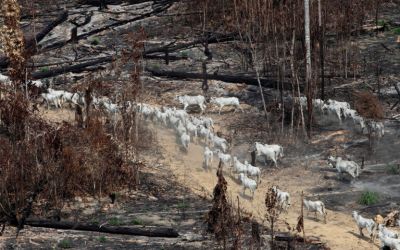
Cleiton Gabriel, the coordinator of the Middle Xingu Ethno-Environmental Protection Front, a specialized Funai unit, told Mongabay via WhatsApp that the forest loss in Ituna/Itatá is caused by land-grabbers who clear the forest without authorization for cattle ranching and other agricultural activities.
“The deforestation in the Ituna/Itatá region historically stems from the illegal occupation of the territory,” Gabriel explained. “This is driven by land grabbing, the establishment of agricultural activities, especially intensive livestock farming, and also smaller-scale laboratory operations, mainly cocoa processing.”
The land use restriction order, which prohibits unauthorized individuals from entering Ituna/Itatá, has been in place since 2011 to protect the isolated people. The precautionary measure has been renewed six times, the most recent being in 2025.
Global Forest Watch data show that Ituna/Itatá was the third-most deforested area in Brazil between 2011, the year of the first land restriction order, and 2021. It was the most deforested Indigenous land in 2019. This has affected Funai’s efforts to obtain evidence of the presence of isolated people in the area, the first step in the formal process to fully demarcate and legally recognize this land. The territory lost 20,000 hectares (49,000 acres) of primary forest between 2002 and 2025 across its 142,807-hectare (352,900-acre) land.
A technical report by the Coordination of the Indigenous Organizations of the Brazilian Amazon (COIAB) states that biodiversity loss and the depletion of natural resources represent a threat to the food security and physical survival of the isolated people in Ituna/Itatá. In addition, the constant presence of invaders poses a serious health risk, given the “extreme immunological vulnerability” of uncontacted peoples.
The Igarapé Ipiaçava people were first detected during the planning of the controversial Belo Monte hydroelectric dam, the largest in the Amazon and the second-largest in Brazil.
In 2023, Brazil’s federal government carried out an operation to remove invaders, clear the land of cattle and prevent further environmental degradation caused by illegal livestock farming in the region. “Since then, deforestation there has ceased,” Gabriel said.
But satellite data seen by Mongabay suggest forest cover loss around ranches inside the reserve continued in 2023 and 2024, with permanent agriculture as the main driver, though it reduced by 75% in 2024 compared with the previous year. In 2025, there was only 10 hectares (24 acres) of forest loss.
Since the 2022 restriction order, IBAMA, Brazil’s environmental agency, handed out multiple fines to occupants in the territory. IBAMA did not provide a comment by the time of publication.
Auzerina Duarte Macuxi, an Indigenous lawyer and the manager of the COIAB Indigenous legal advisory department, told Mongabay in an interview that the illegal invaders in Ituna/Itatá take advantage of a loophole to consolidate irregular land ownership.
Cleiton explained that this begins through the coordinated action of a group of people who organize themselves into associations and divide Ituna/Itatá into plots despite not having a land title.
“Subsequently, they implement productive uses, such as pastures or structures, with the aim of simulating economic exploitation and indicating control over the area,” he said. “This practice is associated with land grabbing, in which deforestation serves as informal evidence of occupation/possession.”
These plots are registered on the Brazilian Rural Environmental Registry (CAR), which is a self-declaratory registry for all rural properties in Brazil. Such registration does not constitute legitimate possession, but it does give the individual a document that can be used to request ownership in legal proceedings at a later date.
“They act in a way that ensures they can claim they are exercising the social function of property once they are in that territory, and then, exercising this right for a time, after having invaded and illegally occupied the land, they use false titles, and they remain there because they have some means to request it through the courts,” Macuxi explained. In addition, “they have the resources to pay lawyers to achieve legalization of the land after the illegal occupation.”
The state agency responsible for managing the CAR is the Secretariat of Environment, Climate and Sustainability (Semas) in Pará. A Semas spokesperson told Mongabay via email the system does not filter to prevent registration in areas of traditional communities.
“The registration process in the system is the sole responsibility of the registrant,” Semas explained, adding that they will investigate the situation in Ituna/Itatá.
To protect the isolated people, Macuxi said all non-Indigenous occupants need to be removed and prevented from entering the land, and the full demarcation of Ituna/Itatá must be completed.
Since the federal operation in 2023, Funai has maintained a base in Ituna/Itatá, “with agents regularly carrying out monitoring, surveillance and inspection activities,” Gabriel said. “Since then, only minor invasion attempts have been recorded, which were promptly contained, keeping the territory under control.”
Banner image: Cattle walk along an illegally burnt deforested area near Novo Progresso, in the northern Brazilian state of Para. Image by AP Photo / Andre Penner.