
Lahore Bar Association moves SC against 27th Amendment following transfer of IHC judges
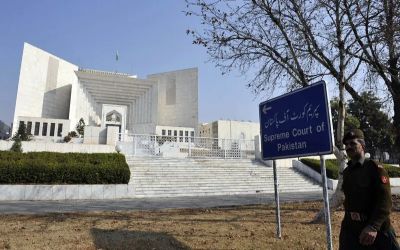
ISLAMABAD: A day after the government notified the transfer of three Islamabad High Court (IHC) judges to other high courts, the Lahore Bar Association (LBA) moved the Supreme Court on Thursday to challenge the constitutionality of the 27th Constitutional Amendment under which these transfers were made. On Tuesday, the Judicial Commission of Pakistan (JCP) approved the transfer of three judges fro
ISLAMABAD: A day after the government notified the transfer of three Islamabad High Court (IHC) judges to other high courts, the Lahore Bar Association (LBA) moved the Supreme Court on Thursday to challenge the constitutionality of the 27th Constitutional Amendment under which these transfers were made.
On Tuesday, the Judicial Commission of Pakistan (JCP) approved the transfer of three judges from the IHC to other courts in a move that drew sharp criticism from lawyers’ bodies for lacking transparency and uniform criteria.
Senior counsel Hamid Khan approached the SC, instead of the Federal Constitutional Court (FCC), on behalf of LBA President Irfan Hayat Bajwa, seeking a declaration that the recent transfer of three judges from the IHC to other high courts is unconstitutional and of no legal effect.
The bar association also requested the SC to declare the omission and repeal of Article 184(3) of the Constitution — an inherent jurisdiction of the SC for the enforcement of fundamental rights but now repealed — through the 27th Amendment as void, unconstitutional and of no effect, being against the basic/salient features of the Constitution.
The petition has also sought a declaration that the now-inserted Article 175(2) — as amended by the 27th Amendment — was void and unconstitutional, and that its formation was also unconstitutional, as it was against the constitutional fundamentals, which the parliament had no power to change or amend.
In the absence of any substantive and disclosed reasons, criteria, or demonstrable institutional necessity, the transfers of IHC judges are unlawful and liable to be declared arbitrary, mala fide in law, and based on extraneous considerations, the petition pleaded.
Similarly, it stated that the transfers had been made without any disclosed reasons, criteria, or demonstrable public interest, thereby rendering the exercise of power arbitrary, opaque, and liable to be set aside.
The Constitution does not contemplate an unstructured or ad hoc exercise of transfer powers; rather, in the present scenario involving multiple transfers, there was a pressing need for a structured, periodic, and across-the-board rotation policy, based on uniform and transparent criteria through law or subordinate legislation, which is conspicuously absent, the petition prayed further.
The petition also argued that the purported 27th Amendment omitted Article 184(3), under which the SC has original jurisdiction to enforce the Constitution and fundamental rights of the people, and that the judicial power of the SC could not be taken away by another branch of the government, i.e., the parliament.
Such an amendment undermines the Constitution and destroys the independence of the judiciary, the petition contended.
The SC being an indivisible judicial institution at the apex, its powers and jurisdiction can not be taken away, the petition emphasised, adding the independence of the judiciary and its necessary parts/concomitants were the appointments, transfers and removal of judges of the superior courts form part of the basic features of the Constitution which were unamendable.
Article 200, having been amended by the parliament, lacked the constituent power as it lacked the mandate and the authority to pass an amendment that destroyed the judicial branch of the government, making it a subservient institution to the executive, which is the biggest violator of people’s rights and mandate, the petition said.
The petition also explained that judges of the FCC, being the beneficiaries and judges in their own cause, and also the creation and its jurisdiction having been challenged through this petition, cannot hear and decide the constitutionality of the 27th Amendment and matters arising thereunder.
Moreover, the action of transfer of judges of IHC under Article 200 as amended by the 27th Amendment cannot be heard by “so-called FCC”, being itself a creation of that amendment, the petition argued.
The petition alleged that the 27th Amendment was a fraud on the electorate and people of Pakistan since neither any of the political parties nor any other member of Parliament had the mandate to vote for the amendment, as they had not been given the mandate to do so by the people.
Nor was it a part of their election(s) manifestos, nor did they have the power to amend the Constitution, as their authority, being a trust as enjoined in the preamble to the Constitution, read with the Objectives Resolution of 1949, which was now a substantive part of the Constitution, could undermine and destroy the independence of the judiciary, the petition stated.
The transfer of judges suffers from the absence of institutional necessity, and in the absence of justification, such actions assume a punitive character, effectively amounting to the removal or sidelining of Judges without due process of law, the petition argued.
Transfer of judges
The transfers from the IHC follow an amendment to Article 200 of the Constitution, which empowers the JCP to recommend such transfers without requiring the consent of the judges concerned. Prior to the amendment introduced through the 27th Constitutional Amendment, a judge’s consent was mandatory for transfer from one high court to another. The revised provision has now vested this authority in the JCP.
It also stipulates that a judge who refuses to accept a transfer may face proceedings under Article 209 before the Supreme Judicial Council.
The transferred judges were among the six who had, in a startling letter written to Supreme Judicial Council members in March 2024, accused the country’s intelligence apparatus of interference in judicial affairs, including attempts to pressure judges through abduction and torture of their relatives and secret surveillance inside their homes.
They were also among the five judges who had formally opposed in February 2025 the then-potential transfer of then-LHC Justice Dogar, warning that his elevation as the IHC chief justice would violate constitutional procedures and judicial norms.
Nevertheless, Justice Dogar was appointed as the acting IHC chief justice on Feb 13, 2025. The next day, he took the oath in a ceremony where all IHC judges were invited, but five of them — including those being transferred — did not attend the ceremony and boycotted it.
Following the development, the IHC went through a major administrative restructuring, which notably reduced the authority of senior puisne judge Justice Kayani — who previously held key decision-making roles — following amendments to the high court rules.
The IHC Administration Committee, previously comprising the chief justice, the senior puisne judge and a senior judge, was restructured to include CJ Dogar and two of his nominees. This reconstitution significantly altered the court’s decision-making authority.
Justice Dogar later took his oath as the IHC CJ on July 8, 2025. And the five IHC senior judges who had opposed his transfer were sidelined in the subsequent reshuffling of key committees.
In September last year, the five judges had submitted separate petitions to the Supreme Court together against a number of issues affecting the court, from the composition of benches to rosters to case transfers.