
'Next Iran'?: Turkey accelerates 60,000 tonnes aircraft carrier amid Israel tensions
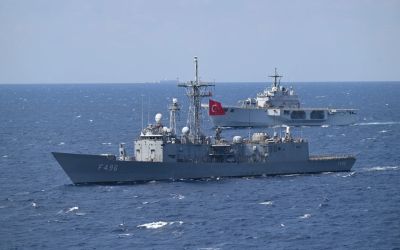
'Next Iran'?: Turkey accelerates 60,000 tonnes aircraft carrier amid Israel tensions Submitted by Ragip Soylu on Wed, 04/29/2026 - 22:02 As Israel likens Turkey to Iran and deepens ties with Greece and Cyprus, Ankara bets on naval power to reassert itself
While the world's attention is fixed on the US blockade of the Strait of Hormuz, Turkish shipyards are busy constructing the country's first national aircraft carrier, the Mugem.
Turkey's Naval Forces Commander Admiral Ercument Tatlioglu said last week that the aircraft carrier is expected to be finished towards the end of next year, creating a buzz.
The statement suggests that the ship’s hull will be completed nearly a year ahead of the originally announced schedule.
The ship, the largest warship ever built in the country, is expected to have a displacement of 60,000 tonnes and measure 285 metres in length. It will surpass the French aircraft carrier Charles de Gaulle (261 metres, 42,500 tonnes), which has until now been the Mediterranean’s most powerful flagship. It is designed to host 60 aircraft, featuring a short take-off system.
Many in Ankara see the rapid progress of the project, which was only launched in August 2025 with the personal attendance of Turkish President Recep Tayyip Erdogan, as a sign that Turkey is determined to build up its arsenal to establish the necessary deterrence capabilities against state actors.
Tensions between Turkey and Israel have recently been running high, with Israeli leaders from both the government and the opposition increasingly likening Turkey to Iran in their rhetoric.
Naftali Bennett, a popular opposition leader who could likely become the next prime minister of Israel, famously told a conference in Washington in February that Turkey was "the next Iran".
Ankara has accelerated projects in air defence and unmanned platforms, as well as the fifth-generation Kaan fighter jet production line, following two rounds of war between Israel and Iran and the US.
Meysune Yasar, an academic specialising in Turkish naval power, said Israel's growing alliance with Greece and Cyprus is pushing Turkey to focus on its naval capabilities.
Even though such aircraft carriers are usually developed for open seas, Yasar says Ankara may see Mugem as a lever that can deter potential hostile actors in the region.
"The warming relations between Greek Cyprus and Israel have made this alliance very effective, and their posture is becoming quite aggressive," Yasar told Middle East Eye.
"Turkey is becoming isolated in the Eastern Mediterranean, and this aircraft carrier is both an additional capability and a strategic necessity."
Building an aircraft carrier isn't a novel idea in Turkey. Its roots can be traced to the early 1990s.
Yanki Bagcioglu, a former admiral in the Turkish navy, said that a concept for open-sea deployments was developed in 1993, which included light aircraft carriers, amphibious assault ships, and transatlantic power projection.
He told MEE that the project materialised around 2017, as a response to a study on the future of the naval force.
"The need for an aircraft carrier came to the forefront," he said.
The original plans, including those for Ankara's drone carrier TCG Anadolu, envisioned the purchase of fifth-generation stealth fighter jets, the F-35. However, Turkey was expelled from the programme in 2019, forcing it to find alternatives.
For now, the Turkish military plans to heavily use the Kizilelma unmanned fighter jet, which has stealth capabilities, along with the Hurjet light combat aircraft and a potential naval version of the Kaan fifth-generation fighter jet on the ship. The Bayraktar TB3, which is already operating on TCG Anadolu with an AI-assisted short take-off capability, will also be deployed.
Alper Coskun, a former Turkish ambassador, said the aircraft carrier project is another sign that Turkey is well positioned within the European security architecture with robust defence industry capabilities.
Coskun, now a senior fellow with the Carnegie think tank in Washington, added that the carrier would elevate Turkey's standing within Nato, as the US calls on allies to contribute more and increasingly signals that it may abandon Europe.