
‘Creamy, nutty’ spiders are protein source for Indigenous Indian tribe
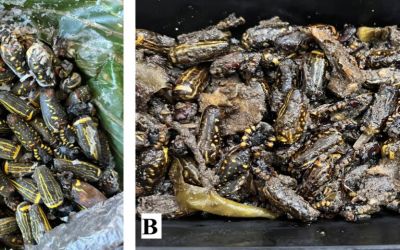
In India’s northeastern Nagaland state, orb-weaver spiders are a sought-after source of protein, according to a new study in Frontiers in Sustainable Food Systems. Here, “edible spiders hold a significant place in the local diet and have been consumed for generations,” study lead author Lobeno Mozhui, from Nagaland University, told Mongabay by email. The researchers […]
In India’s northeastern Nagaland state, orb-weaver spiders are a sought-after source of protein, according to a new study in Frontiers in Sustainable Food Systems.
Here, “edible spiders hold a significant place in the local diet and have been consumed for generations,” study lead author Lobeno Mozhui, from Nagaland University, told Mongabay by email.
The researchers surveyed 33 people with traditional knowledge about the consumption of two orb-weaver spider species: Nephila pilipes and Trichonephila clavata. Both species are locally known as siyankyü in the Lotha Naga language.
Respondents told the researchers that before cooking, they remove the spiders’ head and legs. They then clean and cook them with seasoning, resulting in a “creamy, nutty” and nutritious meat substitute.
The researchers also collected specimens of the two orb-weaver spiders from Nagaland University, and examined their total protein content, with legs removed. Both were rich in protein, ranging from 36.03-73.65% in N. pilipes and 34.17-57.65% in T. clavata — much higher than some commonly eaten insects.
Mozhui said this research is an important baseline and that “the consumption of edible spiders has the potential to gain wider acceptance.”
Arachnophagy, or the consumption of arachnids like spiders, scorpions, ticks and mites, has a long history, the authors write, yet only about 23 of the world’s more than 50,000 known spider species are eaten.
The world’s largest spider, the goliath bird-eater (Theraphosa blondi), is part of the traditional diet of the Yanomamo and Piaroa peoples of the Amazon. Orb-weavers of the genus Nephila are eaten around the world, including in Mexico, Madagascar and Thailand. In Cambodia, tarantulas are sold as street food.
Eraldo Medeiros Costa Neto, from the State University of Feira de Santana in Brazil, who wasn’t involved in the study, told Mongabay by email that spiders “are rich in protein, contain relevant micronutrients like iron and zinc, and generally have a relatively low fat profile.” Like insects, they’re an ecologically efficient food source, he added.
But he warned that harvesting of wild spiders must be carefully managed. Spiders regulate insect populations, so overharvesting them could have “indirect consequences, such as increased pest outbreaks, trophic imbalances, and disruptions to food webs in which spiders also serve as prey,” Costa Neto said.
So why don’t more people eat spiders? Disgust and fear of being bitten are two common reasons. Also, “Spiders are notoriously difficult to farm at scale,” Costa Neto said.
Spiders can be cannibalistic, are territorial, require insect feed, and breed and grow slowly, he said. Web-building species like Nephila are especially challenging to farm because they need a lot of space for their webs.
“Spiders may still hold value as a local or cultural food source, and possibly as a niche gastronomic item,” Costa Neto said. However, “turning them into a significant component of the human diet would require advances in husbandry, automation, and perhaps even domestication — developments that remain a long way off.”
Banner image: Raw and cooked orb-weaver spiders. Image by Mozhui et al., 2026 (CC BY 4.0).