
Chesapeake Bay conservation bolstered by the power of business & viral videos
The Chesapeake Bay is the largest estuary in the U.S., providing key habitat for a huge variety of aquatic life, and it is also home to major cities like Baltimore and Annapolis. That large human footprint is very evident in the bay’s water quality, though, which has suffered greatly from pollution – much of which […]
The Chesapeake Bay is the largest estuary in the U.S., providing key habitat for a huge variety of aquatic life, and it is also home to major cities like Baltimore and Annapolis. That large human footprint is very evident in the bay’s water quality, though, which has suffered greatly from pollution – much of which is invisible, but the rest is quite visible in the form of trash.
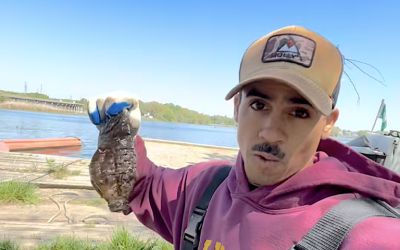
Austin Lewis is a veteran of the Army National Guard and small business owner in the Baltimore area who greatly enjoys his home waters, but increasingly noticed all the debris that floated or coated the bottom of his beloved bay, and so decided to become part of the solution: “I really had no choice but to attempt to do my part,” he told Mongabay in the recent short interview below.
Using the flexibility provided by owning his own insurance firm, Bay Life Brokerage (“Not just a life insurance brokerage, but an agency for environmental change” its homepage says) he can afford to work part time with local conservation group Back River Restoration Committee for hours every day, removing tons of trash while recording very entertaining and informative videos about their shared mission, later posted to various social platforms like Instagram, FaceBook and TikTok under the handle @BayLifeBrokerage.
These often humorous videos also share much natural history information and the Instagram reels in particular garner large numbers of comments and views, all of which extend the reach of the cleanup effort by raising awareness and encouraging viewers to clean the waters near them, wherever they are.
Mongabay: Back River Restoration Committee’s cleanup work is impressive, how does your business also support your part time efforts with them, which actually looks like full time nonprofit stewardship?
Austin Lewis: I participate in cleanups as a part time staff member of the nonprofit, which owns much of the equipment and the boom systems seen in the videos. The power that businesses have to drive a charitable mission as a core company mission is huge, like my business, which funds my time to do cleanup work for 3-4 hours every weekday.
Without the business – and as a husband and father of two kids – I would have to work a normal, 9-5 office job to make ends meet, otherwise I very much doubt I would have the time to work on the events and cleanups.
Most businesses choose to donate money from their bottom line to a charity, but in this day and age, we all too often see charitable donations used inefficiently. By partnering with a charity – and as an employee or owner of your business that physically participates in the change – this ensures your contribution goes much further.
My business also just hosted a cleanup contest, where people went out and performed cleanups on their own, then submitted videos to us via social media, and we chose three winners. We plan to host another cleanup contest toward the end of this summer, and we also make donations to other local nonprofits performing similar work around Maryland.
Mongabay: What drives you to spend so much time and effort to clean up the Chesapeake?
Austin Lewis: I live in Essex, Maryland, a historic waterfront community. I am surrounded by the bay and am an avid boater and fisherman. We get much of our fun, food, and water from the bay. Being so intertwined with my daily life, I could not help but notice the enormous amounts of trash and pollution that pour into my home waters on a daily basis.
Once acknowledged, I really had no choice but to attempt to do my part in helping restore, and hopefully end, this disgusting problem. In some ways, it is also a selfish pursuit, wanting a cleaner and healthier body of water for myself and my family.
Mongabay: How many pounds of waste have you and the volunteers collected so far?
Austin Lewis: The Back River Restoration Committee has removed more than 7 million pounds of trash and debris from of Back River since its founding. Once the waste has been collected, the charity has a partnership with Baltimore County, which picks up material that can be recycled, and sends to a landfill any debris that cannot.
The strangest thing we’ve found so far was a very large bag of unspent ammunition, apparently thrown off a bridge into the Back River. As a gun owner and military member, I know how expensive ammunition is, so it’s very strange to see it wasted in such a way.
Mongabay: How do you find volunteers, and how else do you take action for the bay?
Austin Lewis: The charity we work with generates volunteers through word-of-mouth and, to a large degree, via the social media content I produce both for my business and the charity’s media pages. We also work with other community charities that organize their own cleanup operations, and lobby the government for legislation supporting the Chesapeake.
Mongabay: What positive effects on estuarine health or community engagement have you noticed so far from this effort?
Austin Lewis: Much to my dismay, the trash and other forms of pollution haven’t lessened, but it would appear that more people than ever are aware of it. This has translated to a greater number of volunteers, and support from local businesses.
All that attention has also resulted in the charity we do this work with being awarded the fifth Baltimore Trash Wheel [a large piece of floating equipment that features a pair of containment booms which passively funnel trash onto a conveyor belt and into a dumpster] to be implemented on the Back River within the next few years.
