Global pressure on ayahuasca threatens Amazonian plants and knowledge systems
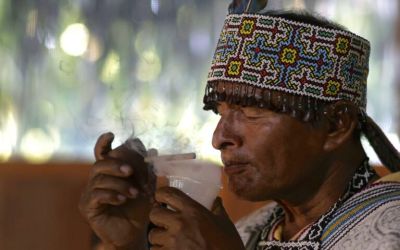
“One of the world’s largest pharmacies is being destroyed,” says Benki Piyãko, a leader of the Ashaninka Indigenous people in the Brazilian state of Acre. The warning points to multiple threats advancing on the Amazon but also to growing debate surrounding one of the so-called forest medicines: ayahuasca. This Indigenous beverage with psychedelic properties is […]
“One of the world’s largest pharmacies is being destroyed,” says Benki Piyãko, a leader of the Ashaninka Indigenous people in the Brazilian state of Acre. The warning points to multiple threats advancing on the Amazon but also to growing debate surrounding one of the so-called forest medicines: ayahuasca.
This Indigenous beverage with psychedelic properties is usually prepared from two native plants: the caapi vine or mariri (Banisteriopsis caapi) and the leaves of the chacrona plant (Psychotria viridis). According to Indigenous leaders and experts, these species are facing increasing pressure and signs of scarcity in some areas.
Called kamarãpe by the Ashaninka people, ayahuasca has been used by Indigenous peoples across the Amazon for centuries. It has crossed borders for decades, ceasing to circulate exclusively in its original contexts. Today, it can be found in urban religious centers, therapeutic retreats, and international psychedelic tourism circuits.
Scientists and pharmaceutical companies are also turning their attention to this ancestral beverage, which already shows evidence of therapeutic potential for different mental health disorders such as depression and substance addiction. But increasing global interest is also creating concerns.
As demand grows, so has the ayahuasca supply chain, without a corresponding growth in management or oversight. In different parts of the Amazon, there are signs of pressure on the species used to prepare the beverage, often collected without planning. At the same time, increasing consumption in nontraditional contexts raises concerns about ancestral knowledge being commodified for the market.
The main problem seems to lie in how this expansion is sustained through an opaque chain connecting the forest to distant markets. Vines and leaves are collected in areas that often lack organized management, pass through intermediaries, and feed a global flow that often operates at the limits of legality.
Even though a resolution by Brazil’s National Council on Drug Policy (CONAD) recognizes the religious use of ayahuasca, the beverage contains dimethyltryptamine (DMT), a psychedelic substance that’s controlled under both Brazilian legislation and international treaties.
At the heart of the controversy is the fact that, while DMT is listed as prohibited, the plants that contain it and the traditional preparations made from them, such as ayahuasca, are not explicitly prohibited, which creates a legal gray area. In practice, the interpretation varies from country to country, and authorities often end up equating ayahuasca with illicit drugs and pushing its circulation into clandestine circuits.
Given the lack of coherent policies on cultivation and protection, there’s growing fear that the ayahuasca hype will put pressure on the forest faster than it can regenerate. “The risk is that ayahuasca will become a market,” Benki says.
“What we see today is people wanting to transform this knowledge into a product,” he adds, emphasizing that ayahuasca is part of a broader context, which is also threatened. “If you say you have spirituality, you must take care of the land.”
For Benki, ayahuasca cannot be dissociated from the set of plants and relationships that sustain life in the forest. “It’s not just ayahuasca that is at risk. A whole plant system is under pressure.” It’s a worldview reflected in the principles that guide his work.
The Indigenous leader lives in the upper basin of the Juruá River, a tributary of the mighty Amazon that forms part of the border between Brazil and Peru. In 2004, he left his territory to head up the environmental department for the border town of Marechal Thaumaturgo. Three years later, he formed a group of about 80 young people to work with agroforestry techniques.
The initiative evolved over the years, and in 2018 it gave rise to the Yorenka Tasorentsi Institute, now focused on recovering degraded areas, establishing agroforestry systems, and strengthening Indigenous governance. Since then, the project has brought together young people, communities, and territories around reforestation practices and food sovereignty, having already planted millions of trees in the region.
In recent years, Benki’s work has begun to engage with a broader agenda: coordinating with Indigenous leaders from different countries to discuss the future of ayahuasca as it gains global popularity. After five Indigenous conferences held in Acre state, where Marechal Thaumaturgo is located, the issue is set to take on an international scale with the World Ayahuasca Forum, scheduled for Sept. 9-13 this year in Girona, Spain.
The last Indigenous Ayahuasca Conference, held in Acre in January 2025, concluded with a joint declaration rejecting “all forms of commercialization of ayahuasca that have established a global market outside ethical limits.” That event was attended by representatives of 34 Indigenous peoples from different countries.
The declaration laid out the set of concerns that have also been gaining traction in Brazil’s institutional debate. That same year, the state of Acre approved the country’s first specific legislation aimed at regulating the extraction, transport, and use of plants involved in the preparation of ayahuasca. That unprecedented initiative, however, has come under criticism.
“Forest medicine is being appropriated without recognition of its origin and the peoples who hold that knowledge,” Ninawa Huni Kuin, chief of the Huni Kuin people, also known as the Kaxinawá, said at a public hearing held by the Federal Prosecution Service of Acre in late 2025, shortly after the new state regulation was announced.
Indigenous leaders, researchers, and Acre state officials attended the hearing. They raised an alert about ayahuasca’s uncontrolled growth in Brazil against the backdrop of effective oversight, regulatory gaps, and increasing commercialization in nontraditional and nonreligious contexts.
In Acre, considered the Brazilian capital of ayahuasca, the regulation approved in 2025 sets distinct parameters for religious groups and formalized organizations. In practice, it allows vines and leaves to be gathered periodically upon notification to the state environmental agency.
Informal groups with no legal status can harvest up to 150 kilograms (330 pounds) of vines and 60 kg (130 lbs) of leaves every four months. Formally established entities have access to larger quotas of up to 1,000 kg (2,200 lbs) of vines and 300 kg (660 lbs) of leaves every six months, as long as they can prove they will use the beverage for ritual, noncommercial purposes.