
Boarding school oral history project to conclude in Tulsa
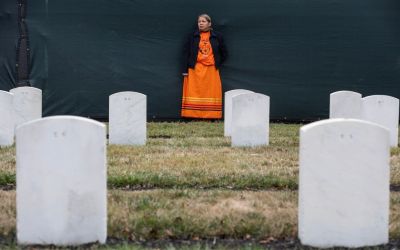
The upcoming event marks the final stop on a nationwide tour to document first-hand accounts from Indian boarding school survivors The post Boarding school oral history project to conclude in Tulsa appeared first on ICT.
A nearly three-year long tour across the United States gathering oral histories from survivors of the Indian boarding school era ends this month, with a final event being hosted June 22-26 in Tulsa, Oklahoma, by the National Native American Boarding School Healing Coalition.
The oral history project provides space for survivors of boarding schools who attended prior to 1970 to share their experiences through professional video interviews. Those interviews will later become part of a permanent collection within the Library of Congress and the Smithsonian Institution.
“This is going to have such an impact across generations,” said Charlee Brissette, who is Anishinaabe (Odawa / Sault St. Marie Ojibwe) and the Oral History Program co-director. “These stories will be preserved for generations, and people, our own communities, will be able to learn from them. The general public will be able to learn from them directly from those that experienced these institutions.”
The project began as part of the U.S. Department of the Interior’s Federal Indian Boarding School Initiative, which has worked to acknowledge, document and reckon with boarding school survivors’ experiences.
Sharing stories of survival is a crucial step in healing, said Boarding School Healing Coalition organizers. Whether happy or sad, all stories are welcome.
“Part of this project is that we want to hear all of the stories, the good, the bad,” said Lacey Kinnart, who is also Anishinaabe from the Sault Ste. Marie Tribe of Ojibwe and an Oral History Program co-director. “(This is) for them to be able to share in this environment and to be believed because for a long time they said they weren’t believed or to validate them. It just gives them this experience that they haven’t had, likely they haven’t had.”
Tens of thousands of American Indian and Alaska Native children attended boarding schools during what is referred to as the Indian boarding school era, which refers to a roughly 150-year stretch from 1819 to 1970 in which Indigenous children were forcibly removed from their homes and taken to schools aimed at assimilating them into European-American society. Those schools were often federally operated or run by Christian organizations funded by the federal government.
Children at those schools were frequently subjected to militarized education with intense manual labor and often corporal punishment. The Department of Interior has identified roughly 1,000 deaths that it believes were caused by the federal boarding schools. However, that number is likely a gross underestimate, with some reports detailing over 3,000 deaths, and the search for other victims continues.
The oral history project began in Oklahoma City in early 2024 and will end right back in Oklahoma after two-and-a-half years of traveling across the country, having made 22 stops along the way.
“We were asked to return to Oklahoma to close in a good way,” Brissette said. “For that opening ceremony (in Oklahoma City), we opened a door. We brought the ancestors in and you know they’ve been looking out for us and watching over us during this project as we’ve been traveling and gathering these stories over the last couple of years and so we’re really excited to be going back and to be closing it you know in a good way, the way that we started.”
The upcoming Tulsa event, which is by appointment only, will run from June 22 until June 26.
“The elders that have chosen to share their stories are very courageous,” Brissette said. “It takes a lot of strength and courage to share these stories.”
The event kicks off with a community feast that is open to everyone, not just survivors or project participants. From June 23-26, organizers will conduct private interviews with survivors. On Friday, June 26, the project ends with a ceremony and an opportunity to honor those who have made the project possible.
“It’s not just wrapping up that week, but it’s wrapping up this whole project, which is a historic, first-of-its-kind oral history project,” Kinnart said.
Both Brissette and Kinnart are descendants of boarding school survivors and both said working on this project has, in turn, helped them heal.
“It helps us personally by seeing, hearing a story from a survivor and (knowing) that happened in my family too,” Kinnart said. “It’s been the honor of a lifetime.”
And each of the 22 stops will have served as a space for survivors to heal through being seen, supported and understood.
“Almost every single week, we hear from survivors that they feel a sense of relief after sharing their story,” Brissette said. “I don’t think that it’s just a matter of them sharing their story and then that’s it, I think it’s a matter of sharing their story in a safe space in this container that we’ve created with relatives. Our team is all Indigenous, we all have connections to the boarding school legacy, and so we know that we have to treat it with care and compassion and empathy.”
She said many of the project participants have expressed that they’ve been living with and hanging onto their story for decades.
“We often say that we’re not the healers. However, we try to create a safe space and a sacred space for that healing to happen,” Brissette said. “We’ve seen it (healing) have ripple effects across the families. It’s absolutely been a life-changing experience to be a part of this project.”
