
Saudi Arabia mulls military escalation in response to Houthi threats
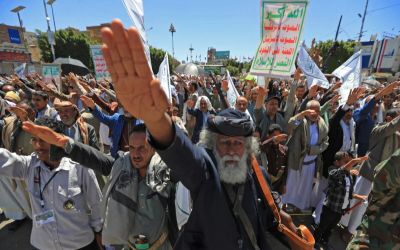
Saudi Arabia mulls military escalation in response to Houthi threats Submitted by Sean Mathews on Thu, 07/16/2026 - 20:52 Saudi Arabian official says the US has given broad remit to pursue offensive strikes on the Houthis
Saudi Arabia is weighing different options to deal with the Houthis, who are escalating their threats against the kingdom in a sign officials and analysts say could forebode a return to fighting in Yemen.
The kingdom’s defence minister, Khalid bin Salman, has suggested that the US is giving Saudi Arabia leeway to pursue offensive strikes against the Houthis, multiple US and regional officials told Middle East Eye. However, its leadership has not made a decision.
One US and one western official said the discussions could point to differences of opinion within the Saudi royal court over how to respond to the Houthi threat as wider fighting between the US and Iran escalates.
The discussions come as a four-year ceasefire between Saudi Arabia and the Houthis is tested by a recent exchange of fighting.
The Houthis inflamed tensions with Saudi Arabia earlier this month after a flight arrived at Sanaa airport to carry Houthi officials to the funeral of assassinated Iranian Supreme Leader Ayatollah Ali Khamenei.
The Houthis accused Saudi Arabia of bombing Sanaa airport to prevent the plane from returning.
The United Nations-backed ceasefire that the Houthis signed with the Saudi-backed internationally recognised government of Yemen has expired, but until now, the sides have generally abided by a framework in which flights to Yemen are from Amman, Jordan, and Cairo, Egypt.
US and regional sources told MEE that the original flight that landed in Sanaa included Lebanese, Iranian, Syrian, and Iraqi military experts specialised in drone and missile technologies. The flight to Iran included Houthi officials tapped to undergo training in Iran, along with senior political figures.
The Houthis retaliated against the Sanaa attack by firing missiles and drones at Saudi Arabia's southwestern city of Abha earlier this week.
A major return to fighting between the two sides would not only add to Yemen’s humanitarian crisis but also shake energy markets and the Saudi economy, which is already navigating the Iran war.
Since Iran has attempted to assert its control of the Strait of Hormuz, the Red Sea has become the main artery for Saudi Arabian oil exports. The kingdom is sending roughly 4.5 million bpd of oil through the Red Sea via its East-West Pipeline.
“I’d hate to be a Saudi today. There is no easy solution to Yemen,” Mohammed al-Basha, a US-based Yemen expert, told MEE.
“A peace deal [with the Houthis] would mean billions of dollars in reparations, while a return to war has 50-50 odds of a Saudi victory,” he said.
The Houthis launched attacks on global shipping in the Red Sea following the Hamas-led 7 October 2023 attack on southern Israel. The group said its attacks were in solidarity with besieged Palestinians in Gaza, and it won support across the Arab and Muslim world.
US President Donald Trump ordered a wide-scale bombing campaign against the Houthis in 2025. He eventually stopped the attacks ahead of a visit to the Gulf in response to lobbying by Saudi Arabia, MEE revealed at the time.
Although the Houthis officially sat out the war that erupted after the US and Israel attacked Iran in February, Gulf and US officials who spoke with MEE widely believe that the Houthis were responsible for some land strikes on Saudi Arabia.
A former US official said the larger problem for both sides was that the UN-mandated ceasefire had “long reached its expiration date”, but no alternative has been found to resolve the conflict and advance a political settlement.
The Houthis control the Yemeni capital of Sanaa and much of the populated northwest, while Saudi Arabia backs an internationally recognised government based in Aden.
“The no war, no peace stalemate has not produced any outcome closer to a political settlement,” Ibrahim Jalal, an independent expert on Yemen and the Arab Gulf, told MEE. “The Houthis' anti-Saudi rhetoric has also flared up.”
Houthi leader Abdul Malik al-Houthi threatened Saudi Arabia in a televised speech aired on Thursday.