
Arch Connelly, beloved mainstay of the 1980s East Village art scene, steps into the spotlight
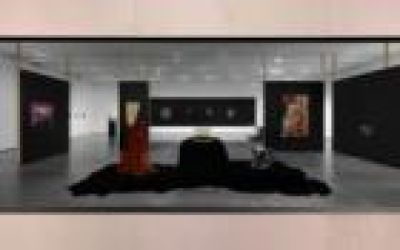
The late artist’s first-ever institutional survey at the Aspen Art Museum honours him through its theatrical staging, featuring works on loan from friends like Agosto Machado and Jimmy Wright
reviewArch Connelly, beloved mainstay of the 1980s East Village art scene, steps into the spotlightThe late artist’s first-ever institutional survey at the Aspen Art Museum honours him through its theatrical staging, featuring works on loan from friends like Agosto Machado and Jimmy WrightElena Goukassian13 July 2026ShareInstallation view of Arch Connelly: Straighten Your Wig and Pray, Aspen Art Museum, Colorado, 2026 Photo: Paul Salveson, courtesy Aspen Art Museum
The late artist Arch Connelly (1950-93) loved theatricality. Immediately after graduating from college in 1973 with a degree in ceramics, he moved to San Francisco and immersed himself in its experimental, gender-fluid theatre communities—designing lavish sets and costumes for the legendary troupe the Cockettes and its off-shoot, Angels of Light. After relocating to New York in 1980, Connelly became a beloved mainstay of the East Village’s thriving gay community, counting among his friends artists like Jimmy Wright, Agosto Machado and Martin Wong.
Connelly was known for his faux pearl-encrusted paintings and sculptures, which he displayed dramatically on black walls and plinths draped in velvet. He liked to say that he saw sculpture as furniture and painting as sets, and his works appeared frequently in exhibitions at Fun Gallery—at times alongside those of Keith Haring, Jean-Michel Basquiat and Kenny Scharf. One of Connelly’s pieces was included in the New Museum’s 1982 group show Extended Sensibilities: Homosexual Presence in Contemporary Art, the first institutional exhibition dedicated to the work of gay artists. He even made the cover of Artforum in 1991.
But the artist’s untimely death at age 43 from Aids-related complications cut his career short, and his work has been largely overlooked. Now, more than 30 years later, his first-ever museum survey is on view at the Aspen Art Museum in Colorado.
Installation view of Straighten Your Wig and Pray Photo: Paul Salveson, courtesy Aspen Art Museum
Straighten Your Wig and Pray (until 11 October) celebrates Connelly’s devotion to theatre by displaying more than 50 of his works—gathered largely from his friends and family, and shown together for the first time—in a gallery designed in a way the artist would have appreciated. Curators Stella Bottai and Daniel Merritt worked with the theatre director and designer Fabio Cherstic, using photos of Connelly’s shows and his sketches for exhibition-design ideas, to create a space that pays homage to the artist’s unique aesthetic sensibility. Like Connelly’s work, “the show is a collage in and of itself”, Bottai says, creating what the artist liked to call “aquariums and dioramas” for his art.
The first act of the exhibition, so to speak, appears in the form of three vitrines of sketches, photos, documents, letters and other ephemera contributed by Connelly’s friends, family and gallerists.
Among these is his Pink Manifesto, written in lieu of an artist statement for his first show in 1980 at Artists Space in New York. The declaration starts with an all-caps pronouncement of Connelly’s love of the colour pink. He then goes on to define his work with adjectives like “mannered”, “homosexual” and “effete”, and ends with “TTITEERRIIFFIICCLLYY TTRRAANNSSIIEENNTTTTT TTTRRAAAASSSSHHHHHH”. (Connelly was known for his sense of humour. “He was very funny,” Bottai says, “which is something everyone we talked to told us.”)
Many of the letters on view are addressed to Jimmy Wright, one of Connelly’s closest friends. Wright has been instrumental in honouring Connelly and his work, donating their correspondence to the Whitney Museum of American Art in 2018 and giving pieces he had received as gifts to major institutions in New York and Chicago. Wright worked closely with Bottai and Merritt on the Colorado exhibition, as did many of Connelly’s other friends and family.
“It was going to be a much smaller show,” Bottai says. “It started with a few key friends and built up in a cumulative way from a core group of people devoted to preserving his legacy.” She adds that many of the works on loan for the exhibition had been proudly displayed in the houses of Connelly’s loved ones for years.
Connelly often made art for his friends, including a delightful pearl-covered spoon for Agosto Machado, who also worked with the museum on the show before his death in March. The two friends shared a love for assemblage.
Connelly’s Ideal Variable (1985) includes pennies, eggshells and faux pearls Photo: Travis Roozée, courtesy the estate of Arch Connelly and Corbett vs Dempsey, Chicago
Like Machado, Connelly created three-dimensional collages with found objects. But Machado’s were precious mementos collected from loved ones, whereas Connelly used materials that had no special meaning. Instead, Connelly's materials created an illusion of value—like the fake pearls he was so fond of, acquired through a friend who worked in fashion. He also made work with pennies. And when he used broken eggshells, collected from his day job as a cook on the brunch shift, he often painted them gold or silver. It seems Connelly was going for trash Rococo (a term he likely would have appreciated).
It comes as no surprise that Connelly was a huge fan of camp. “Camp is an amorphous concept,” he told David Hirsh, the journalist and cofounder of the Visual Aids Archive, in 1993. “But it has to do with saying: ‘You think this is ugly? I think this is pretty. I’m going to show you that this has other ideas.’ It’s surrealistic in the way it turns things around.”
Installation view of Straighten Your Wig and Pray Photo: Paul Salveson, courtesy Aspen Art Museum
While Connelly’s unique style and attention to texture is instantly recognisable, his works span a multitude of forms—from landscapes to functional furniture to collages of erotic imagery that he referred to as “modern-day religious art”. (As the artist told Hirsh, the goal was to “canonise the saints we have today, which would be in porn”.) But one quality all of Connelly’s works possess is a palpable tension between opposites—nature and artifice, value and worth, devotion and disgust, desire and entrapment. This is at times beautiful, as in his surrealist landscapes, but can also be dark and foreboding, like his series of pearl spiderwebs hanging loosely from their frames.
The title of the Aspen exhibition comes from a 1987 work that hangs right next to the gallery door, a crucifix encrusted in pearls with a small mirror in the middle. The mirror is smudged, tiny and barely functional. Like Connelly’s neighbouring “self-portraits”, accumulations of thousands of pearls or sequins with no face in sight, the work pokes fun at the vanity in us all. As Connelly well knew, life is a performance.