
How to stitch a massive wildlife corridor through the Rocky Mountains
BRITISH COLUMBIA, Canada — On a sunny Thursday in May, Kent Kebe had to scrape yet another bighorn sheep carcass off Highway 93/95 running through Radium, British Columbia. The necropsy confirmed what Kebe, the village’s protective service manager, already knew: A car collision killed the ram. Roadkill deaths hit this community hard. Residents love their […]
BRITISH COLUMBIA, Canada — On a sunny Thursday in May, Kent Kebe had to scrape yet another bighorn sheep carcass off Highway 93/95 running through Radium, British Columbia. The necropsy confirmed what Kebe, the village’s protective service manager, already knew: A car collision killed the ram.
Roadkill deaths hit this community hard. Residents love their sheep so much that the village center sports a huge steel sculpture of sheep horns that stands roughly 12-meters- (39-foot-) wide and 6-meters- (19-feet-) tall. The Big Horn Cafe on the main drag features artwork of bighorn rams and serves custom-blended “Headbanger tea.”
In the 1990s, about 350 bighorn sheep (Ovis canadensis) milled around, drawn to the golf course and the grasses along the highway. “It’s like a candy store for them,” Kebe says. But by 2022, the herd’s numbers had dwindled to 140. While some sheep died from natural causes, vehicle collisions played a big role in the death toll.
“There’s a tension where the sheep are the mascots of the village, but the traffic is killing them,” says wildlife scientist Clayton Lamb, who works with the nonprofit Biodiversity Pathways and the University of British Columbia. He helped bring attention to the issue in 2022.
Habitat loss is a major threat to species, but highways, railways and towns impact how animals move to eat, meet and mate — and that can endanger their survival. A 2025 review in the journal Science warned that while the world aims to protect 30% of the planet by 2030 under the U.N. Global Biodiversity Framework, isolated areas will become “genetic dead ends” if they remain disconnected.
“Habitat is great, but if it’s an island and not connected to other habitats, it can result in local species dying off,” says Tim Johnson, the landscape connectivity specialist with the nonprofit Yellowstone to Yukon Conservation Initiative (Y2Y).
Early efforts to link habitats began decades ago, and sometimes all it took was a single animal corridor — an overpass, underpass or a protected strip of land — to build a pathway from one safe haven to another.
But the conservation world is now prioritizing connectivity, recognizing the critical need to reconnect continuous stretches of the landscape, rivers, flyways and marine corridors. This is what it takes to help entire ecosystems thrive, Johnson says.
Y2Y, launched in 1997, was among early pioneers of landscape-scale conservation with an ambitious vision: To create one giant connected area that stretches from the Greater Yellowstone ecosystem in the U.S. northwards to Canada’s Yukon Territory.
“If we don’t get it right there, then we’ve lost the most intact, connected, wild, large mountain region in the world,” says Jodi Hilty, Y2Y’s president and chief scientist. The initiative has already protected more than 9.8 million hectares (24 million acres) of habitat, linking corridors, and has supported construction of some 204 wildlife crossings.
But what does it take to build a “corridor” that stretches 3,400 kilometers (2,100 miles) and spans five U.S. states, two Canadian provinces and at least 75 Indigenous territories?
It requires a mosaic of projects that range in scale and approaches, Hilty says, taking a “hearts and lands” approach. It’s a question of building connections between different partners, learning from centuries of Indigenous stewardship — and using science to inform decisions that work for both wildlife and humans.
And most of all it requires learning about what’s needed, what works and sometimes, what doesn’t.
Driving along Highway 3, which crosses the Rocky Mountains in southern British Columbia and Alberta, wildlife biologist Clayton Lamb points out a familiar sight: An abandoned vehicle with a crumpled hood, smashed windshield and shattered headlights. Tufts of elk (Cervus canadensis) fur stick out from the windshield wipers.
To secure the Y2Y vision, it’s important to look to where the corridor is most threatened, Hilty says, and that includes a stretch of Highway 3 from Hosmer, B.C., to Rock Creek in Alberta.
It slices through a narrow section of the Rockies where the animals are funneled into a tight corridor of survival, just 70 km (43 mi) wide. More than 300 collisions between vehicles and large mammals occur here each year, and the animal death toll is so high that two large morgues are stationed along the section for the battered carcasses. “The highway is like a predator that never sleeps,” Lamb says.
It’s not just a problem of roadkill. The mere presence of the road and the noise of traffic can deter animals from nearing it, creating an obstacle to their movement, Lamb says.
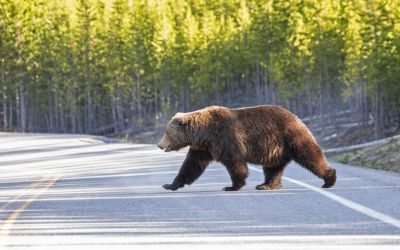
He’s put GPS collars on grizzly bears (Ursus arctos horribilis), elk, deer and bighorn sheep — and tracked their behavior with collaborators from the B.C. government and colleagues from Alberta. The data they gathered revealed dozens of kilometers of highway where the elk simply won’t cross.
For those that do attempt to cross, the consequences can be dire. The road cuts through Elk Valley, which provides ideal habitat for many species including the grizzly bears that thrive on spring vegetation and berries and an abundance of elk and mule deer (Odocoileus hemionus). But vehicle collisions, along with human-bear conflict, kill 5 – 8% of these grizzlies each year according to research published in 2020 in the Proceedings of the National Academy of Sciences. The population only remains stable thanks to immigrant bears that move into the valley.
While all roads deter wildlife movement to some degree, the threats posed by Highway 3 are particularly severe because the geography allows such a small passageway. “If we cut the Rockies in half at Highway 3, then we lose the Y2Y vision,” Hilty says.