
Haiti drops 5 spots in FIFA rankings after World Cup
FIFA's ranking system rewards teams for results against stronger opponents while placing greater weight on competitive matches than friendlies. For Haiti, this means the World Cup losses outweighed the gains made during qualifying. The post Haiti drops 5 spots in FIFA rankings after World Cup appeared first on The Haitian Times.
Haiti dropped five places to No. 88 in FIFA's latest men's world rankings following its 2026 World Cup campaign. The rankings, released one day after Spain defeated Argentina in the World Cup final, reflected each national team's five most recent match results.
MIAMI — Haiti’s national men’s team fell five places to No. 88 in FIFA’s 211-nation rankings after its historic return to the FIFA World Cup. But fans and leaders of the team are unfazed, vowing Les Grenadiers will climb back up soon enough.
“With the quality of its current players, Haiti is in a better position than it has ever been,” a Haitian Football Federation insider, who requested anonymity for not being an authorized spokesperson, told The Haitian Times via a WhatsApp message.
Haitian soccer fan Walter Jean-Jules, of Miami, said the team’s ranking decline was expected after it lost to Peru in a friendly and to all three of its group-stage matches at the World Cup.
“It’s no surprise,” Jean-Jules said. “The only question was how far down we were going to slide. I am glad we are still in the top 90s.”
Released one day after Spain defeated reigning champion Argentina in the World Cup final, the rankings were calculated using each national team’s five most recent international match results.
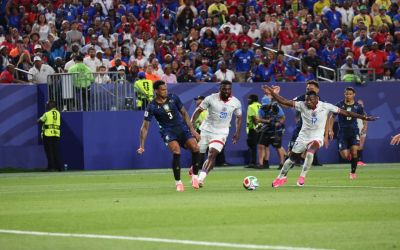
For Haiti, those matches included three World Cup defeats: a 1-0 loss to Scotland, a 3-0 defeat to Brazil, and a 4-2 loss to Morocco. FIFA’s ranking formula also factored in Haiti’s final two pre-World Cup friendlies—a 4-0 win over New Zealand and a 2-1 defeat to Peru.
Although Haiti finished last in Group C without earning a point, its performances were against opponents ranked well above it. That helped Les Grenadiers avoid dropping too far and maintain its top-10 position in the CONCACAF region, a benefit for group seeding as Haiti prepares to enter the Nations League as a regional elite team in League A.
The current place is Haiti’s lowest ranking since now-former head coach Sébastien Migné took over in March 2024. Before the World Cup, Haiti had climbed steadily in the FIFA rankings after an unbeaten run in the CONCACAF Nations League and securing its first appearance at soccer’s biggest tournament in 52 years.
“Haiti has a strong team that will get back to winning ways in the region when the Nations League kicks off in September,”
Les Grenadiers won their Nations League group, qualified for the expanded 48-team World Cup and arrived in the tournament with a roster composed almost entirely of players developed in the Haitian diaspora. The World Cup, however, exposed the gap that still separates Haiti from the world’s elite powers. Defensive lapses proved costly against Scotland and Brazil, while Morocco capitalized on limited opportunities despite Haiti’s improved attacking display.
FIFA’s ranking system rewards teams for results against stronger opponents while placing greater weight on competitive matches than friendlies. For Haiti, this means the World Cup losses outweighed the gains made during qualifying.
Still, many Haitian soccer observers argue the ranking tells only part of the story. It does not reflect the team’s true value and strengths, they say.
Samuel Colin Jean, a youth coach in Haiti for over 10 years, believes the national team will climb right back and even to a better position soon.
“Haiti has a strong team that will get back to winning ways in the region when the Nations League kicks off in September,” Jean said. “I have no doubt this team, which is now ranked in CONCACAF’s 8th place, will be in the region’s top 5 before the 2027 Gold Cup.”
Despite finishing without a point, Haiti demonstrated it could compete for stretches against some of the world’s strongest teams. Players earned praise for their resilience, particularly in the match against Morocco, while supporters celebrated the country’s return to the World Cup after a half-century absence.
The tournament also rekindled national and Haitian diaspora interest in soccer. At the stadiums and online, Haitians and non-Haitians alike cheered for Les Grenadiers. After the team’s campaign, thousands of supporters welcomed returning players during homecoming celebrations in Cap-Haïtien, Bas-Limbé, Port-au-Prince, Les Cayes, Camp-Perrin, Jacmel and other communities.
Looking ahead, Haiti’s next objective will be reversing the slide in the rankings as preparations begin for the next cycle of regional competitions and 2030 World Cup qualification. With a new head coach expected to be appointed soon, the federation hopes the experience gained on the world’s biggest stage will provide a foundation for sustained progress rather than a one-time achievement.
Loading… Related Fritznel D. Octave fritznel@haitiantimes.com facebookxinstagramlinkedinbluesky Award-winning journalist and writer Fritznel D. Octave is a distinguished professional serving as Haiti Editor of The Haitian Times. His educational journey includes a bachelor’s degree in Social Communication from the Faculté des Sciences at the State University of Haiti, professional studies at the University of the West Indies in Jamaica, and the University of Oxford in England, UK, culminating in an MBA from Florida Atlantic University in the United States.
With nearly three decades of experience covering news about Haiti, his latest book "Haiti Between Pestilence And Hope" is a testament to his unwavering commitment to impactful storytelling and social journalism. The issues he tackles range widely from social justice and politics to the environment, healthcare, and economics. Beyond journalism, Fritznel specializes in business growth strategy and personal development.