
Reliving Terror: Romanians Learn What Secret Police Interrogations Were Really Like
New exhibition uses original video recordings of Securitate interrogations to reconstruct communist regime’s mechanisms of repression – and counter growing nostalgia for the communist period.
On November 12, 1989, officers from the Securitate, Romania's communist-era secret police, stormed the Bucharest apartment of 39-year-old engineer Constantin Geangu, an employee of a state-owned foreign trade company.
He was taken to the Criminal Investigations Directorate of the Securitate, where investigators informed him that he faced up to 15 years in prison on charges of "anti-socialist propaganda".
Geangu was accused of sending nine anonymous letters over the previous two years to senior officials of the Romanian Communist Party.
Using a letter stencil to conceal his identity, he urged sweeping political and economic reforms, including free elections, an independent judiciary and measures to tackle the chronic shortages of food, electricity and other necessities; these had come to define everyday life in Romania during the final years of Nicolae Ceausescu's dictatorship.
What followed were hours of relentless interrogation, during which Securitate officers alternated between calculated politeness and open intimidation in an effort to force a confession.
Geangu, however, refused to admit wrongdoing, insisting that he had merely described reality and exercised his conscience. At one point, the head of the Central Detention Centre entered the interrogation room and delivered a blunt ultimatum: “We can speak civilly if you agree to confess, or not so civilly if you refuse.”
Those chilling words were captured on video by the Securitate itself. The recording, preserved in the archives of Romania’s former secret police, is now being shown to the public for the first time as part of the exhibition “A.REST 1989”.
By combining archival documents with original video recordings, the exhibition reconstructs the mechanisms of repression employed by the secret police in the final months before the collapse of Ceausescu’s regime.
A guided tour of the “A.REST 1989” exhibition in Bucharest. Photo: Mihai Demetriade.
The exhibition focuses on the cases of three people investigated by the Securitate, including Geangu, and features a series of previously unseen interrogation tapes. The recordings offer a rare insight into the psychological pressure, threats and coercive methods employed against political detainees during the final weeks of the communist regime.
“We wanted to show how the Securitate operated, how investigations were conducted, how officers built criminal cases and what actually happened inside the interrogation rooms and detention facilities,” said Mihai Demetriade, a historian at Romania’s National Council for the Study of the Securitate Archives, CNSAS, and the exhibition’s curator. “Until now, very little was known about these procedures,” he added.
According to Demetriade, the newly uncovered material shows that the Securitate’s abuses extended beyond psychological intimidation. “We now have proof that violence was used inside detention facilities. This was not limited to psychological pressure, but also included physical torture, particularly beatings,” he added.
Only those cases considered most serious under the communist regime were brought to the Central Detention Centre in Bucharest.
These included offences classified as “hostile propaganda against the state order”, such as the critical letters written by Geangu, displaying anti-regime messages in public places, distributing leaflets or attempting to cross the border illegally. The prison sentences for such offences ranged from five to 15 years.
Far more common were so-called “preventive” actions. People suspected of engaging in activities deemed hostile to the regime were summoned to Securitate headquarters, interrogated and threatened with punitive measures against both themselves and their families. They were subsequently placed under surveillance and kept under constant monitoring.
The Securitate was established after the communist takeover in 1948 to protect the new regime through surveillance, repression, censorship and intimidation.
At its peak, it had some 11,000 officers and relied on a vast network of informers, estimated at around 600,000 people, although the exact figures remain disputed.
An automatic desk telephone with a surveillance technology facility. Photo: BIRN/Marian Chiriac.
Coming back to the exhibition space, its visual and emotional impact is striking. At its centre stands a reconstructed prison cell, furnished with a narrow bed, an empty metal bowl and a cup, evoking the isolation and deprivation experienced by detainees.
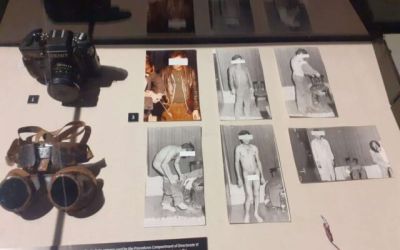
Surrounding the cell, visitors can watch or listen to footage from the interrogations on grainy, wall-mounted monitors. Displayed between the screens are artefacts from the investigators’ arsenal, including a surveillance monitoring device and a pair of glasses used to prevent detainees from “seeing where they were going or identifying” other people.